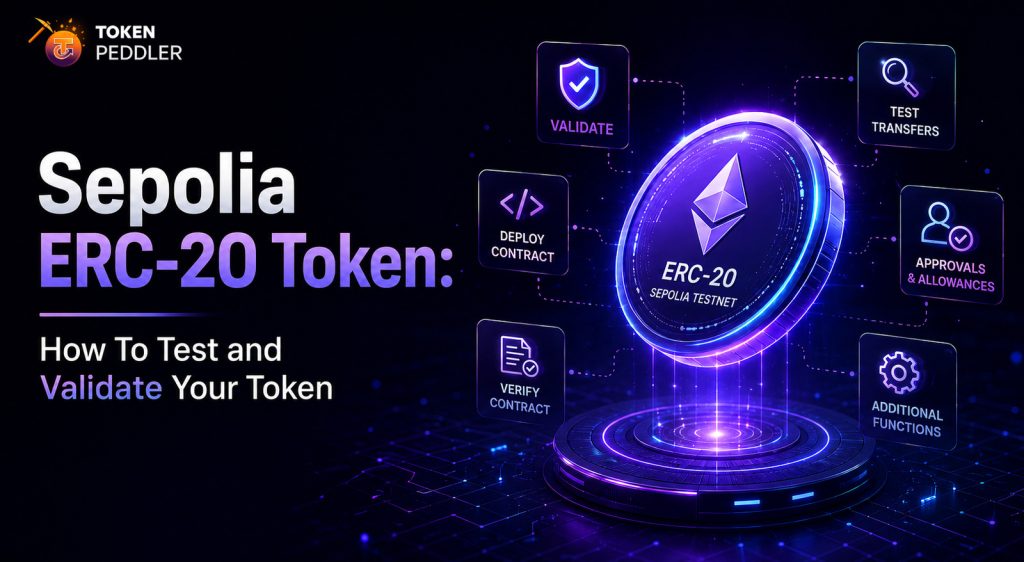
Creating an ERC-20 token is only the beginning. Before putting a token on Ethereum mainnet, developers need to make sure the contract behaves as expected, transactions work correctly, and token functions do not introduce unexpected risks.
That is where Sepolia comes in.
Ethereum Sepolia is a test network designed to provide an environment where developers can deploy and interact with smart contracts without using real ETH. For anyone experimenting with a new token, it offers a practical way to test everything from deployment and transfers to minting, burning, and wallet compatibility.
Whether you are a developer building a Web3 application or a startup exploring custom token generation, testing a Sepolia ERC20 Token before mainnet deployment can save considerable time and reduce avoidable mistakes.
What Is a Sepolia ERC-20 Token?
A Sepolia ERC20 Token is essentially an ERC-20 compatible token deployed on Ethereum’s Sepolia testnet rather than the Ethereum mainnet.
The ERC-20 standard defines a common set of functions that tokens can use, including transferring tokens, checking balances, approving spending, and allowing another address to spend tokens on behalf of the owner.
Sepolia provides a safe testing environment for these functions. Since the network uses test ETH rather than real funds, developers can experiment without exposing actual assets to unnecessary risk.
For example, you can deploy a token with:
- A custom name and symbol
- A defined initial supply
- Specific decimal settings
- Transfer functionality
- Minting or burning capabilities
- Ownership or administrative controls
The important point is that a testnet token is not a real mainnet asset. Its purpose is validation, experimentation, and development.
Why Test Your Token on Sepolia Before Mainnet?
Deploying directly to Ethereum mainnet may seem straightforward, but small mistakes in a token contract can become expensive once real transactions are involved.
Testing first allows you to identify problems before users interact with the token.
A proper Sepolia testing process can help you verify:
Contract deployment: Make sure the contract deploys successfully and returns the expected address.
Token balances: Confirm that the initial supply is allocated correctly.
Transfers: Send tokens between multiple wallets and verify that balances update properly.
Approvals: Test the approve, allowance, and transferFrom mechanisms used by many decentralized applications.
Administrative functions: If the contract supports minting, burning, pausing, ownership transfers, or other controls, test each function carefully.
Wallet compatibility: Import the token into compatible wallets and check whether the name, symbol, decimals, and balance appear correctly.
These checks are especially important during custom token generation, where the token may include functionality beyond a basic ERC-20 implementation.
How an Ethereum Sepolia Token Generator Can Help
Building a token contract manually is possible, but it requires familiarity with Solidity, contract compilation, deployment tools, and wallet interactions.
An Ethereum Sepolia Token Generator can simplify the process by providing a structured interface for configuring and deploying a test token.
Instead of starting with a contract file, developers can typically define the token parameters through a form-based workflow. Depending on the platform, this may include the token name, symbol, supply, decimals, and other available features.
For beginners, this reduces the technical barrier. For experienced teams, it can also make initial prototyping faster.
However, a generator should not replace validation. A token that deploys successfully is not automatically a token that has been tested thoroughly.
The deployment is only one part of the process.
Step-by-Step: How to Test a Sepolia ERC20 Token
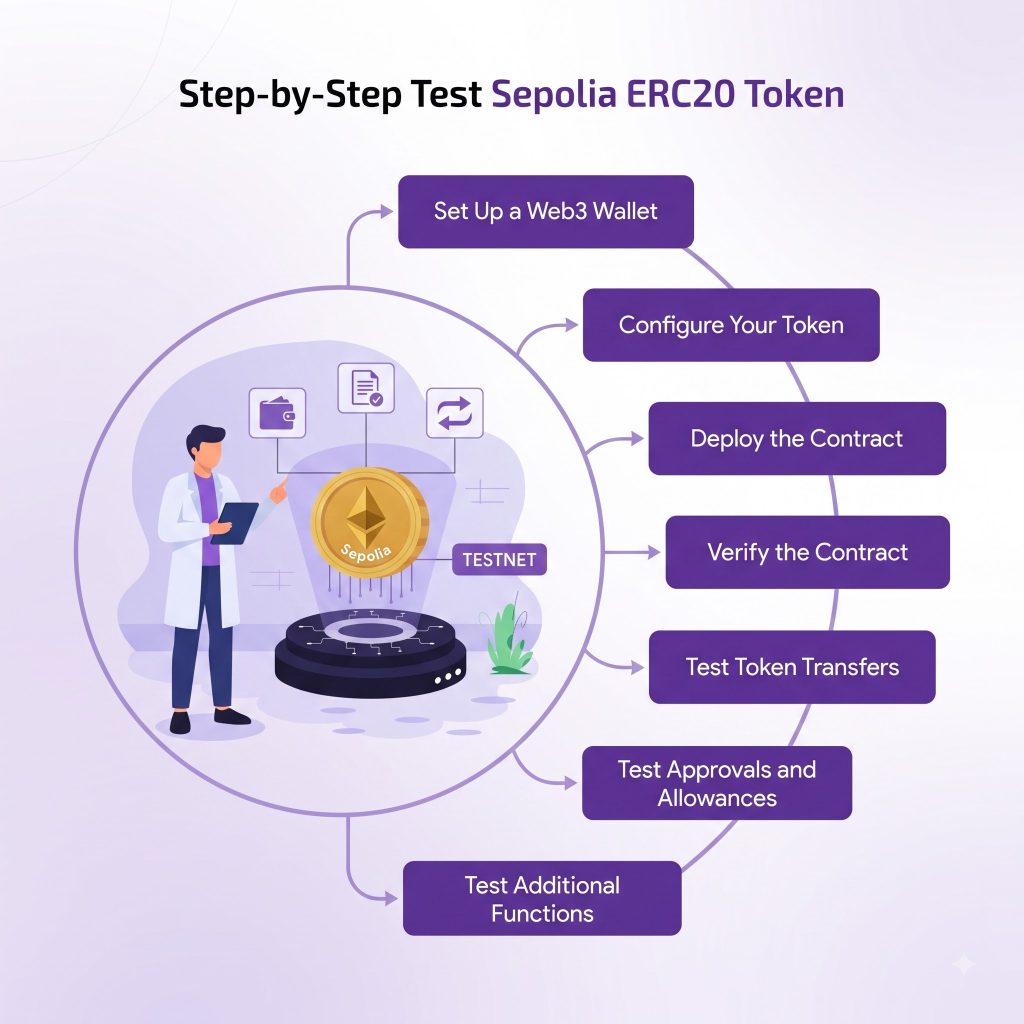
1. Set Up a Web3 Wallet
Start with a wallet that supports Ethereum and Sepolia. Make sure you are connected to the Sepolia network rather than Ethereum mainnet.
Your test wallet will need Sepolia ETH to pay transaction fees. Testnet ETH has no monetary value, but it is required for submitting transactions.
2. Configure Your Token
Using an Ethereum Sepolia Token Generator or your preferred development environment, define the token parameters.
Pay particular attention to:
- Token name
- Symbol
- Total supply
- Decimal places
- Owner or administrative address
- Optional token functions
Double-check these values before deployment. A simple configuration error can lead to unnecessary redeployment and testing.
3. Deploy the Contract
Connect your wallet and deploy the contract to Sepolia.
After the transaction is confirmed, save the contract address. This address identifies your token contract on the testnet and will be useful when reviewing transactions or adding the token to a wallet.
Do not confuse the contract address with your wallet address.
4. Verify the Contract
After deployment, inspect the contract through a Sepolia-compatible blockchain explorer.
Check whether the contract address is correct and whether the deployed contract exposes the expected functions.
If source-code verification is available for your development workflow, verify the contract so that its functions can be inspected more easily.
5. Test Token Transfers
Send a small amount of your Sepolia ERC20 Token between different test wallets.
Check the sender’s balance, recipient’s balance, and transaction status.
Repeat the test with different amounts. This can help reveal issues related to decimals, supply calculations, or transfer restrictions.
6. Test Approvals and Allowances
ERC-20 applications frequently rely on token approvals.
Test the approval process and confirm that a designated address can spend the permitted amount through transferFrom.
Also test what happens when the approved amount is exceeded. Edge cases are often where unexpected contract behavior becomes visible.
7. Test Additional Functions
If your token supports features such as minting, burning, pausing, or ownership management, test each one independently.
For example, if minting is restricted to an owner address, verify that an unauthorized wallet cannot mint additional tokens.
Security is not just about checking whether a function works. It is also about checking whether it can be called by someone who should not have access.
What Should You Validate Before Mainnet Deployment?
Once basic functionality works, perform a broader validation.
Token Economics
Confirm that the total supply, distribution model, decimals, and allocation addresses match your intended tokenomics.
Access Control
Review who can perform administrative actions. An incorrectly configured owner or privileged address can create serious operational problems.
Transaction Behavior
Test successful and unsuccessful transactions. Don’t only test the “happy path.” Try invalid amounts, unauthorized actions, and other realistic edge cases.
Wallet Display
Add the token to supported wallets and verify that the token name, symbol, decimals, and balance are displayed correctly.
DApp Compatibility
If the token will interact with a decentralized application, test the complete workflow rather than testing the contract in isolation.
For example, a token may transfer correctly while an approval-dependent application still has an integration problem.
Common Mistakes When Testing ERC-20 Tokens
Before moving from Sepolia to mainnet, keep these common testing mistakes in mind.

Check Deployment
Deployment success doesn’t mean your token is production-ready.
Test Multiple Wallets
Test different wallets, addresses, and transaction scenarios.
Keep Parameters Fixed
Avoid changing token settings after completing your tests.
Record Test Results
Document the contract, configuration, address, and testing outcomes.
Can Token Peddler Be Used for Sepolia Testing?
Platforms such as Token Peddler can make the initial token creation process more accessible for users who want to experiment with blockchain tokens without writing a smart contract from scratch.
Its token-generation workflow can be useful for testing different token configurations and understanding how a token behaves before considering a production deployment.
The important distinction is that a token generator helps simplify custom token generation; it does not eliminate the need for proper testing, security review, or responsible deployment practices.
For teams preparing a production token, Sepolia should be treated as a testing stage rather than a substitute for a professional smart contract audit.
Final Thoughts
A successful token launch is not simply about creating a contract and deploying it. The quality of the testing process can make a significant difference when that contract eventually handles real assets.
Using a Sepolia ERC20 Token gives developers a practical environment for testing transfers, approvals, balances, permissions, wallet integration, and other important functionality without putting real funds at risk.
An Ethereum Sepolia Token Generator can further simplify the initial creation process, particularly for teams exploring different configurations or carrying out early-stage custom token generation.
The best approach is simple: build, test, validate, review, and only then consider moving to mainnet.
FAQ’s
What is a Sepolia ERC20 Token?
A Sepolia ERC20 Token is an ERC-20 compatible token deployed on Ethereum’s Sepolia testnet. It is primarily used for development, testing, and experimentation before a potential mainnet deployment.
Is Sepolia ETH real money?
No. Sepolia ETH is testnet ETH intended for development and testing. It does not have the same economic value as ETH on Ethereum mainnet.
Why should I test an ERC-20 token before mainnet deployment?
Testing helps identify problems with transfers, approvals, balances, access controls, wallet integration, and other contract functions before the token interacts with real assets.
Can I create a Sepolia token without coding?
Yes. An Ethereum Sepolia Token Generator can simplify token creation through a no-code or low-code interface, depending on the platform. However, you should still test and validate the resulting contract before considering a production deployment.
Is a Sepolia token automatically ready for Ethereum mainnet?
No. A successful Sepolia deployment does not guarantee that a token is production-ready. Before mainnet deployment, review the contract, test its functionality thoroughly, check access controls, and consider an independent smart contract security audit.