
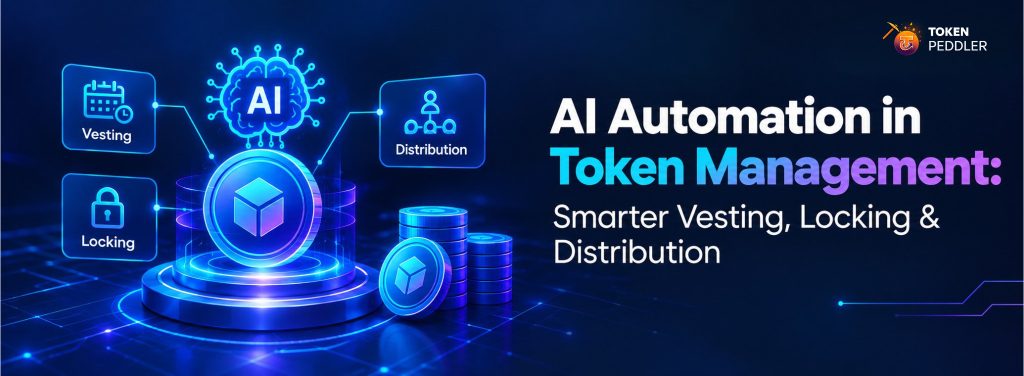
Managing a token after deployment can be more complicated than creating it in the first place. Once a project goes live, teams have to handle vesting schedules, token locks, investor allocations, team distributions, treasury movements, and sometimes thousands of wallet addresses.
This is where AI automation in token management is changing the way teams approach custom token development. Instead of relying entirely on spreadsheets, manual approvals, and repetitive wallet operations, blockchain projects can use automation to make token management more structured, predictable, and easier to monitor.
For businesses planning to create my token projects, automation is becoming less of an optional feature and more of a practical way to reduce operational mistakes.
Why Token Management Needs Automation
Launching a token is only one part of a tokenization project. The real work often begins after deployment.
Consider a project with 10,000 investors, a 12-month vesting period, monthly releases, and different allocation categories for founders, advisors, and the community. Managing those obligations manually can quickly become difficult.
A small error in a spreadsheet or wallet address can lead to incorrect distributions. Even when the underlying smart contracts are secure, poor operational processes can create unnecessary risks.
AI-powered automation can help organize these workflows by monitoring schedules, identifying upcoming actions, checking predefined rules, and triggering supported processes with minimal manual intervention.
The goal is not to remove human oversight. Instead, it is to make repetitive token operations more consistent while allowing the team to focus on strategy, product development, and community growth.
Smarter Vesting Management With AI
Vesting is commonly used to gradually release tokens allocated to founders, employees, investors, advisors, or strategic partners.
Traditional vesting management often involves maintaining schedules manually and checking release dates one by one. As the number of stakeholders increases, this approach becomes harder to maintain.
AI automation can connect vesting schedules with predefined rules and monitoring systems. For example, a project could track:
- Token allocation for each wallet
- Cliff periods
- Monthly or quarterly release dates
- Amounts already distributed
- Remaining locked balances
- Upcoming unlock events
For teams involved in custom token development, this creates a more organized way to manage token commitments after launch.
AI can also assist with reporting by highlighting unusual changes, missed actions, or upcoming distribution requirements. However, important financial and blockchain operations should still have clearly defined approval controls rather than relying on AI decisions alone.
Automated Token Locking for Better Control
Token locking is another area where automation can make a noticeable difference.
Projects may lock tokens for liquidity, team allocations, treasury reserves, partnerships, or other predefined purposes. Once a lock is established, manually tracking every unlock date can become inconvenient.
An automated system can monitor lock conditions and provide notifications before an unlock occurs. More advanced workflows can connect the lock schedule with smart-contract functions, allowing authorized actions to happen according to predefined rules.
This can improve operational transparency because teams can maintain a clear record of what is locked, why it is locked, and when the applicable conditions change.
For anyone looking to create my token project with long-term tokenomics in mind, these controls should ideally be considered before deployment rather than added as an afterthought.
AI-Powered Token Distribution
Token distribution can become particularly challenging when a project needs to send tokens to a large number of wallets.
A bep20 token generator, for example, may simplify the initial token creation process on BNB Smart Chain, but distribution is a separate operational requirement. The same principle applies to projects building tokens on other networks.
Automated distribution systems can help teams organize recipient lists, allocation amounts, transaction batches, and distribution schedules.
AI can assist by checking structured distribution data for potential issues such as:
- Duplicate wallet addresses
- Missing allocation information
- Incorrect token amounts
- Unexpected wallet changes
- Distribution schedules that do not match the approved plan
The final transaction should still be governed by appropriate wallet permissions, smart-contract controls, and human approval. AI is most useful as an automation and monitoring layer rather than an unrestricted authority over blockchain funds.
From “Create My Token” to Managing the Entire Lifecycle
Many teams initially search for solutions because they want to create my token quickly. Token creation, however, is only the beginning of the lifecycle.
A successful token project may need ongoing support for:
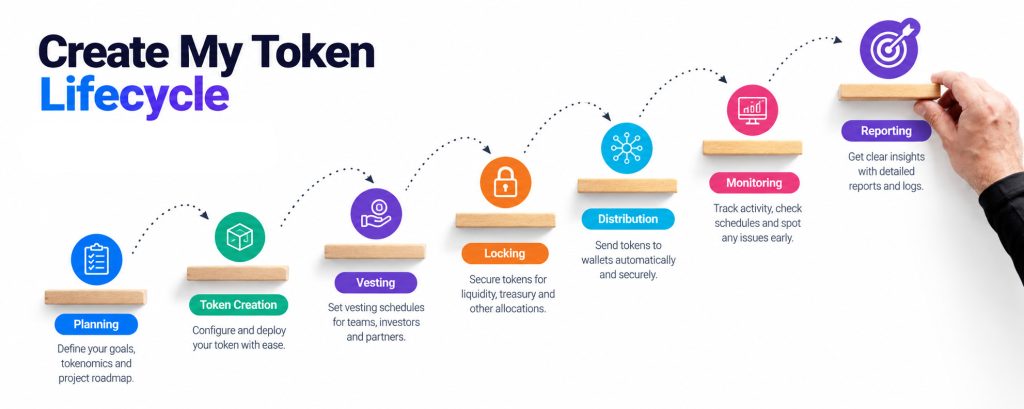
Planning → Token Creation → Vesting → Locking → Distribution → Monitoring → Reporting
This broader lifecycle is where automation can deliver more value.
For example, a project using custom token development can establish token rules during the planning stage and then connect those rules with operational workflows after deployment. Instead of rebuilding the process every time tokens need to be distributed, the team can work from predefined schedules and permissions.
This approach also makes it easier to document how tokens move between wallets and allocation categories.
Solana and BNB Smart Chain Use Cases
Automation is not limited to one blockchain ecosystem.
Teams planning to create solana token projects can use automated workflows for allocation management, scheduled distributions, treasury monitoring, and other operational processes supported by their infrastructure.
Similarly, teams using a bep20 token generator can build BEP-20 tokens and then establish structured workflows for vesting, locking, and distribution on BNB Smart Chain.
The important consideration is not simply which network is being used. Teams should evaluate transaction requirements, smart-contract capabilities, wallet infrastructure, security controls, and the complexity of their tokenomics before selecting an automation approach.
Security Still Comes First
AI can make token management faster, but automation does not automatically make a system secure.
Projects should establish clear permission structures before automating token operations. Private keys should be protected appropriately, transaction approvals should be controlled, and smart contracts should be reviewed before handling significant token balances.
It is also important to maintain transaction records and make critical operations auditable.
In practical custom token development, automation should therefore be treated as one layer of the overall architecture. Smart-contract security, wallet management, access control, testing, and monitoring remain equally important.
How Token Peddler Fits Into the Process
Platforms such as Token Peddler can simplify the starting point for teams that want to move from token planning to deployment without building every basic token-generation function from scratch.
For businesses exploring custom token development, a no-code token creation workflow can make it easier to configure token details, select supported networks, and prepare a project for its next stage.
The bigger opportunity comes when token creation is considered alongside vesting, locking, distribution, and long-term management. Teams can first establish their token structure and then determine which operations should be automated and which should remain under direct human approval.
That combination helps create a more practical token management strategy instead of treating deployment as the finish line.
The Future of Automated Token Management
AI is unlikely to replace the people responsible for managing blockchain projects. Its more realistic role is to reduce repetitive work and improve visibility across complex token operations.
As token ecosystems become more sophisticated, teams will increasingly need systems that can monitor schedules, organize distributions, identify inconsistencies, and provide useful operational insights.
Whether a business plans to create my token, launch a Solana asset, or use a bep20 token generator, the long-term success of the project depends on much more than the initial deployment.
The combination of automation, smart-contract controls, human oversight, and transparent reporting can provide a stronger foundation for managing tokens throughout their lifecycle.
FAQs
How can AI help with token vesting?
AI can monitor vesting schedules, identify upcoming unlocks, organize allocation data, and flag inconsistencies. Actual token releases should operate through predefined smart-contract rules and appropriate authorization controls.
Can AI automate token distribution?
Yes. AI can assist with recipient verification, allocation checks, scheduling, transaction preparation, and monitoring. Human approval and secure wallet controls should remain part of important distribution workflows.
Is a BEP-20 token generator enough for complete token management?
A bep20 token generator can help with token creation, but complete token management may also require vesting, locking, distribution, treasury management, monitoring, and reporting systems.
Can I use automation when I create a Solana token?
Yes. Teams that create solana token projects can incorporate automation into supported distribution, monitoring, allocation, and treasury workflows. The exact implementation depends on the project’s technical architecture and requirements.
Why is automation important in custom token development?
Automation reduces repetitive manual tasks and can help teams manage complex schedules and distributions more consistently. However, it should complement not replace, security reviews, access controls, smart-contract testing, and human oversight.