
Asset tokenization is changing how businesses represent, manage, and transfer ownership of real-world assets. From real estate and private equity to bonds, commodities, and investment funds, companies are exploring blockchain-based solutions to improve transparency, automate processes, and expand access to digital markets.
However, choosing the right platform is not simply about creating a token. Enterprises must consider regulatory requirements, smart contract security, investor management, blockchain compatibility, and long-term scalability.
This guide explores the top asset tokenization platforms to evaluate for 2027, their key capabilities, and the factors businesses should consider before investing in tokenization infrastructure.
What Is an Asset Tokenization Platform?
An asset tokenization platform provides the technology and infrastructure needed to represent ownership rights or financial interests in an asset through blockchain-based tokens. Depending on the provider, it may support token issuance, investor onboarding, compliance checks, asset management, transfers, and reporting.
For example, a real estate company could tokenize eligible interests in a property-holding entity, while an investment firm could issue blockchain-based representations of fund interests.
The important distinction is that a digital token does not automatically establish legal ownership of an underlying asset. The legal structure, investor rights, custody arrangements, and applicable regulations must support the intended use case.
For enterprises, selecting a platform means finding a solution that connects blockchain technology with existing business operations and legal obligations.
Top Asset Tokenization Platforms to Consider in 2027
The following providers serve different parts of the tokenization ecosystem. They are presented by their primary capabilities rather than as a universal ranking, because a regulated securities issuer and a software infrastructure provider do not perform the same role.
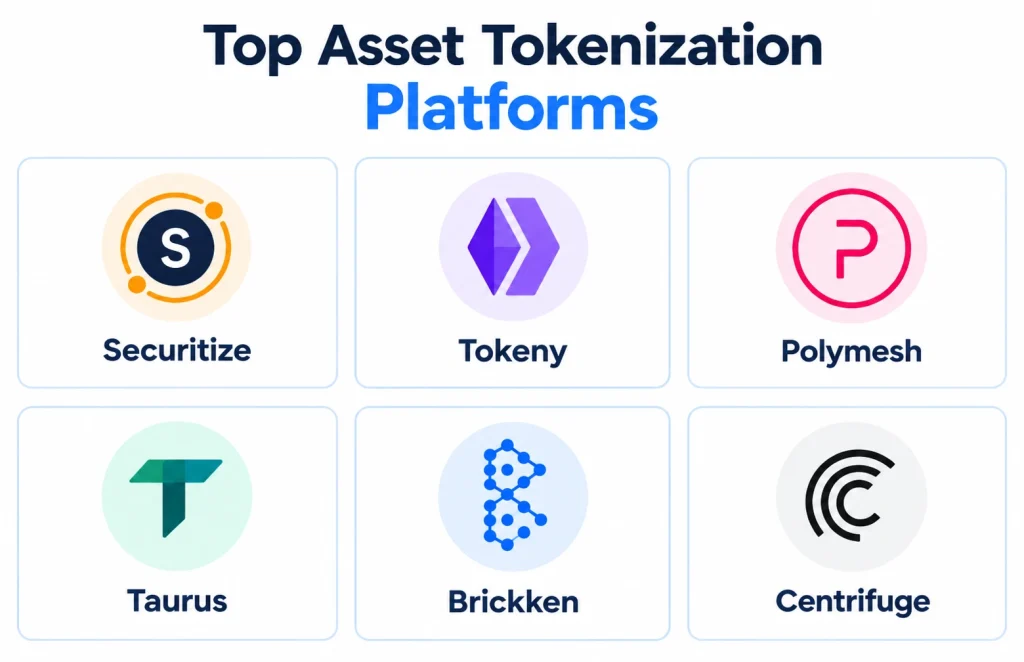
1. Securitize
Securitize is a prominent option for businesses exploring institutional digital securities and tokenized investment funds. Its infrastructure supports regulated issuance and investor servicing, making it relevant to financial institutions, fund managers, and eligible investors.
The platform is worth evaluating when a project requires investor onboarding, ownership records, compliance controls, and integration with regulated financial processes.
Key consideration: Enterprises should confirm the specific services, investor eligibility requirements, and jurisdictional coverage available for their intended offering.
2. Tokeny
Tokeny focuses on tokenization infrastructure for digital securities and real-world assets. Its technology is associated with ERC-3643, a token standard designed to support permissioned transfers and identity-based compliance controls.
This approach can be useful for organizations that need more than basic token transfers. For example, a business may need to restrict transfers to verified investors or enforce eligibility conditions through smart contracts.
Key consideration: Evaluate identity integrations, transfer restrictions, investor lifecycle management, and the operational responsibilities that remain with the issuer.
3. Polymesh
Polymesh is a blockchain network designed specifically for regulated financial assets. Rather than operating only as a token creation application, it provides blockchain infrastructure intended to accommodate identity, governance, and compliance requirements.
This focus can appeal to businesses that need a network designed around regulated asset workflows instead of adapting every requirement to a general-purpose blockchain.
Key consideration: Assess ecosystem maturity, integrations, custody options, developer requirements, and the costs of operating on the network.
4. Taurus
Taurus provides digital asset infrastructure for financial institutions, including technology associated with custody, tokenization, and trading.
Banks and established financial businesses may prefer this type of provider when digital assets need to fit within existing security controls, governance procedures, and financial infrastructure.
Key consideration: Confirm which services are available in the relevant jurisdiction and whether the proposed implementation fits existing banking and compliance systems.
5. Brickken
Brickken offers tokenization technology aimed at helping businesses represent real-world assets digitally. Its potential applications include real estate, private markets, and other assets where issuers need structured issuance and investor management workflows.
Businesses exploring tokenization for the first time may find this category of platform useful because it can reduce the amount of infrastructure they need to develop independently.
Key consideration: Review the platform’s legal and compliance integrations, supported asset structures, reporting capabilities, and total implementation costs.
6. Centrifuge
Centrifuge focuses on bringing real-world assets into blockchain-based financial markets, particularly through tokenized credit and investment structures.
Its ecosystem is relevant to businesses and financial participants exploring how assets such as receivables, credit exposures, and investment funds can interact with decentralized finance infrastructure.
Key consideration: Understand the underlying asset structure, issuer responsibilities, liquidity limitations, and risks associated with the relevant investment product.
Platform capabilities can change. Before making a decision for 2027, verify current documentation, supported networks, pricing, licensing arrangements, and availability directly with each provider.
How to Choose the Right Asset Tokenization Platform
Comparing providers by brand recognition alone can lead to expensive implementation mistakes. Enterprises should evaluate the technology against the asset, business model, and regulatory environment.
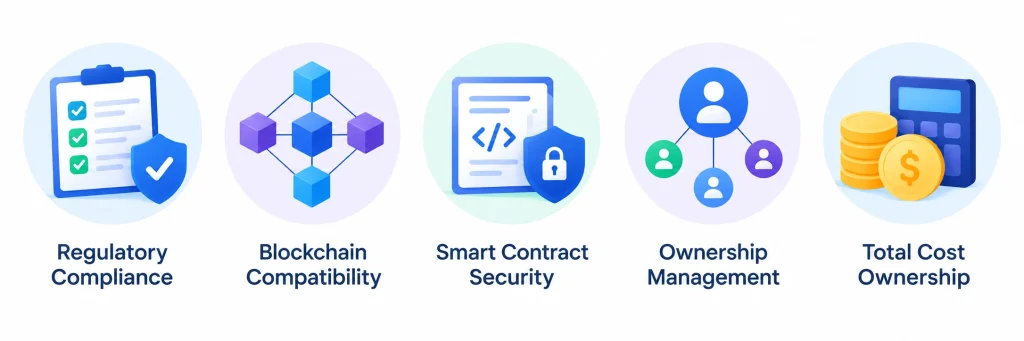
Regulatory Compliance
Compliance should be considered before token issuance begins. Depending on the asset and jurisdiction, requirements may include investor identity verification, eligibility checks, anti-money-laundering procedures, transfer restrictions, and regulatory reporting.
A platform can provide technical controls, but it does not automatically make an offering legally compliant.
Blockchain Compatibility
Evaluate transaction costs, network security, ecosystem integrations, and future scalability. Ethereum and its layer-2 networks are worth considering for established smart contract infrastructure, while other networks may better suit particular business requirements.
Enterprises should also consider how easily the solution integrates with wallets, custody providers, payment systems, and existing enterprise software.
Smart Contract Security
Smart contracts determine how tokens behave after deployment. Depending on the project, they may manage issuance, transfers, investor restrictions, distributions, or redemption workflows.
Independent security audits, controlled administrative permissions, documented upgrade procedures, and incident-response planning are important safeguards.
Ownership Management
Tokenization continues long after the initial issuance. Enterprises may need to maintain investor records, manage distributions, process eligible transfers, and produce financial or regulatory reports.
Choose a platform that supports these operational requirements rather than focusing exclusively on token creation.
Total Cost of Ownership
Consider development, licensing, legal review, security audits, custody, integrations, transaction fees, and ongoing maintenance. A low-cost launch may become expensive if the platform cannot support future requirements.
Custom Token Development vs. Ready-Made Platforms
Not every enterprise needs a fully customized tokenization system. The right approach depends on the complexity of the asset and the level of control required.
Ready-made platforms can accelerate deployment by providing existing workflows and infrastructure. However, organizations with specialized business logic, unique investor requirements, or complex integrations may benefit from custom token development.
A custom solution can provide greater control over token functionality, permission structures, integrations, and administrative processes. It also introduces additional responsibilities for security testing, maintenance, and regulatory alignment.
Businesses that want to create a token for a straightforward utility or ecosystem use case may need a different solution from a financial institution issuing regulated investment products. The underlying objectives should determine the architecture.
For simpler blockchain projects, a BEP20 token generator may help streamline token creation on BNB Smart Chain. However, generating a standard token is not equivalent to building a complete asset tokenization platform. Regulated assets may require additional legal, identity, custody, and transfer-control infrastructure.
Where Token Peddler Fits In
For businesses and founders exploring blockchain token creation, Token Peddler offers a practical starting point. Its no-code token creation platform helps users configure tokens without having to write smart contracts from scratch.
Users can explore supported networks, define token parameters, and access token management capabilities depending on the selected network and available features.
Token Peddler may be suitable for teams that want to simplify token creation before moving toward more advanced blockchain initiatives. For enterprises planning a regulated asset offering, it is still important to evaluate whether additional custom development, legal structuring, compliance integrations, and security reviews are required.
The objective is to choose technology that fits the project rather than adding unnecessary complexity from the beginning.
Conclusion
The best asset tokenization platform for 2027 depends on what a business intends to tokenize, who will hold the tokens, and which legal and operational requirements apply.
Securitize and Tokeny are worth examining for institutional issuance and compliance-focused workflows. Polymesh offers purpose-built blockchain infrastructure, Taurus focuses on financial institution infrastructure, Brickken supports business-oriented tokenization, and Centrifuge is relevant to tokenized credit and asset financing.
Before committing, assess compliance, security, scalability, integrations, and long-term operating costs. Start with a clearly defined use case, validate the legal structure, and test the technology before expanding.
For teams beginning with token creation, Token Peddler can provide a straightforward way to explore blockchain tokenization. More complex enterprise projects should build on that foundation with the appropriate legal, technical, and compliance expertise.
FAQ’s
- What are asset tokenization platforms?
Asset tokenization platforms convert real-world asset rights into blockchain-based tokens and help manage issuance, compliance, and transfers.
- Which asset tokenization platform is best for enterprises in 2027?
Top options include Securitize, Tokeny, Polymesh, Taurus, Brickken, and Centrifuge. The best choice depends on your assets, compliance needs, and business goals.
- Is custom token development necessary for asset tokenization?
No. Ready-made platforms suit standard needs, while custom development supports specialized features, integrations, and compliance rules.
- Can a BEP20 token generator be used for asset tokenization?
Yes. A BEP20 token generator can create tokens on BNB Smart Chain, but regulated assets may require legal structuring, investor verification, and transfer restrictions.
- How can Token Peddler help businesses get started?
Token Peddler offers no-code token creation on supported blockchains, helping businesses launch tokens without writing smart contracts from scratch.