A few years ago, if anyone wanted to create a token, it meant that they had to hire blockchain developers, write the token code and launch the contracts manually without the smallest mistake of even a semicolon. But the time has changed since 2025 because token creation has come to a point where if you want to create a token, there is no coding required. Anyone, whether they are a small startup or a global brand, can create their own token in minutes using modern, secure, and user-friendly no-code platforms.
The reason behind the popularity of such platforms is that the demand for digital assets and asset tokenization is growing so fast. People want tokens to represent community rewards, loyalty programs, in-game items, digital shares, or even ownership of the real world in minute fractions.
And the best part is that they do not need any coding experience to do it because platforms like Token Peddler lets you create your own crypto token with custom properties and launch smart contracts with no code.
So, let us explore how this revolution shapes tokenization, what you need to prepare and what the exact steps are to mint and launch your own token.
What was the actual problem and how does the no-code solution solve it?
Traditional token creation was a very developer-heavy task because you needed to understand blockchain architecture, gas management, contract libraries, and security audits before you could even think about deployment. It directly made the innovation much slower and expensive for businesses for a long time.
That is exactly the problem that no code token creation platforms solve. They provide ready-to-deploy templates for ERC20 and other standards and let users create smart contracts without coding. You simply have to just enter your token name, symbol, supply, and decimals; toggle between advanced options like “can mint” or “set transaction fee”; and just click on deploy. The system automatically handles compilation, validation, and on-chain deployment, where you just have to approve from your wallet.
The individuals and companies who are trying to access asset tokenization can do it faster and safer in their own ways with a low learning curve. It means you do not have to understand Solidity, Rust, or any deployment scripts, and all you have to do is have your focus on what matters the most: the purpose and value behind your token.
Why are token creation tools your best bet?
Anyone who has a faster time to market is the winner in the modern tech era, as businesses that wait months for development cycles lose their advantage to faster innovators. Then it does not matter what no-code crypto token creator platforms you have used to launch the solution.
Here are why token creation platforms are worth using if you want to launch your own token instantly:
- Speed because you can design and deploy your token within minutes.
- Simplicity because these platforms have clean interfaces that guide you through each setting.
- Security because these templates are pre-audited and reduce the smart contract risks.
- Customization because you are the one deciding the supply caps, minting rules, and fees of the token.
- Compatibility because the platforms have support for all major chains and let you connect multiple wallets.
These tools easily turn the complex process into an accessible one for instantly deploying smart contract operations across multiple networks while also focusing on community, marketing, and growth. If you are building something new, a DeFi token, a membership token, or an NFT-style utility, a no-code asset tokenization platform provides everything in one secure, browser-based setup.
Preparing the basics and understanding the environment
Before hitting on the create token or steps, one must understand the foundation containing terms like “wallet,” “blockchain network,” and “token type.” This will be your key to a good token creation process:
Wallets
A wallet stores your crypto and gives you authorization to blockchain interactions because you will need to pay gas fees and then confirm the deployments. The most common wallets that are popular among the token creators are as follows:
- MetaMask works across Ethereum and EVM-based chains like BSC and Polygon, is easy for browser integration and has strong community support.
- Software that is ideal if you are going to use Solana tokens, as they are fast and just built for Solana’s ecosystem.
- Phantom, Trust Wallet, and Coinbase Wallet are some other wallets that support multiple blockchains with simple connection flows.
Your wallet is your digital key to create, sign, and deploy smart contracts with no code with the maximum security. It makes sure that the final token belongs to your address and not a third-party developer or company.
Blockchain Networks
Next you have to understand the blockchain on which your token will be live. Here Ethereum remains the most popular network because of its reliability and wide ERC20 token adoption, but new networks like Solana, Polygon, and Avalanche are also fast in transactions and have lower gas costs. And of course each network has their own benefits, like Ethereum, which is best if you want reach, liquidity, and ecosystem support as compared to Polygon (EVM), which is ideal for lower gas fees, compatibility, and Ethereum tools.
Solana is the best one for high throughput and for fast transactions as compared to the BNB Smart Chain, which is very budget friendly and also compatible with EVMs with a wide support. So, selecting the right blockchain defines how users interact with your token, like whether they want speed, cost-effectiveness, or compatibility.
Token Standards and Categories
Once your wallet and network are ready, you have to choose the standards for your token, which defines your token behaviour and its interaction with blockchain.
- ERC20 tokens are the standard for fungible tokens and perfect for currencies, loyalty programs, and governance systems.
- BEP20 tokens are great for Binance’s equivalent of ERC20 and are used on the BNB smart chain.
- SPL tokens are Solana’s native token standard, which are excellent for speed.
- ERC721/1155 are non-fungible or semi-fungible tokens that are used for NFTs or collectibles.
Your token creation platform will show these standards during setup so choose one as per your goals and audience reach.
Steps to create your own token without coding
Now that you have a clear understanding about the environment, let’s walk through the exact process. The beauty of platforms like Token Peddler is that you can create smart contracts without coding so you just have to fill out a few fields.
Step 1: Select your blockchain and wallet
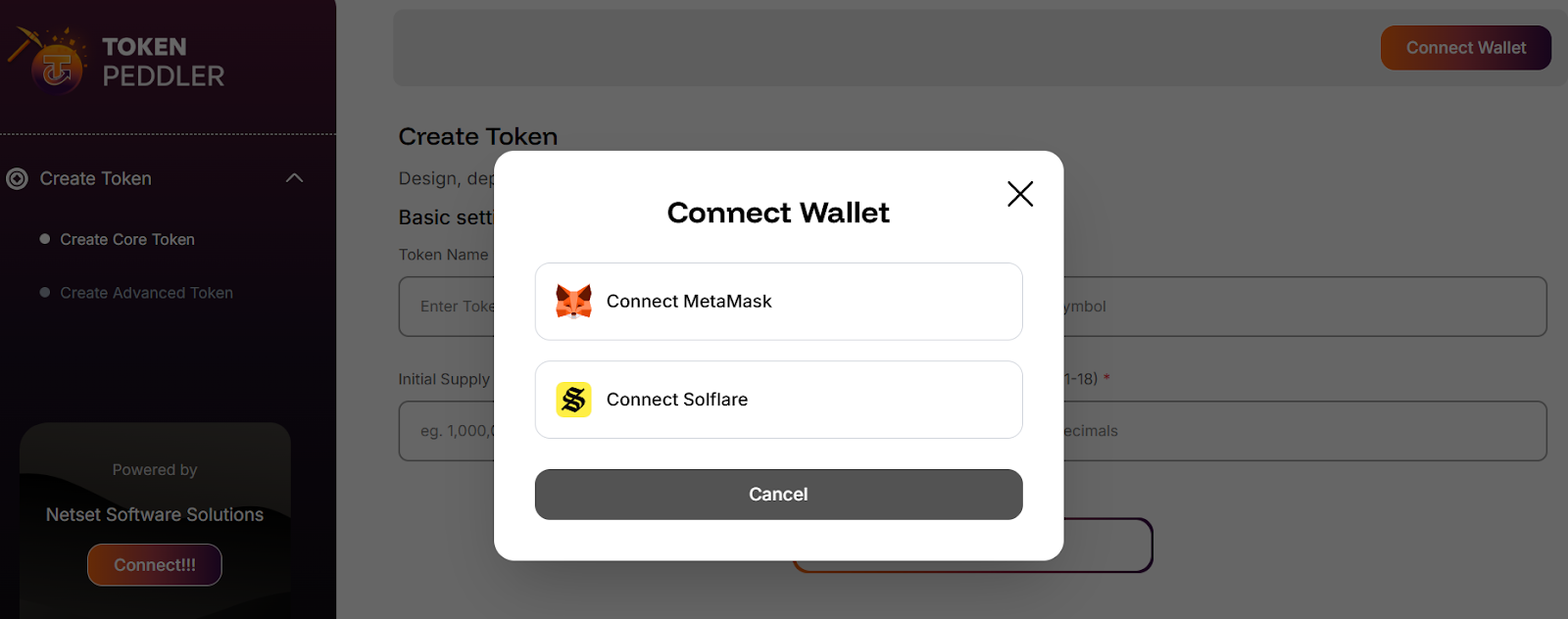
You have to start by deciding on your blockchain network like Ethereum for an ERC20 token or something else. Then you have to connect your wallet, which in most cases is MetaMask or Solflare. Your wallet will act as your on-chain identity and transaction signer.
Step 2: Define the properties of your token
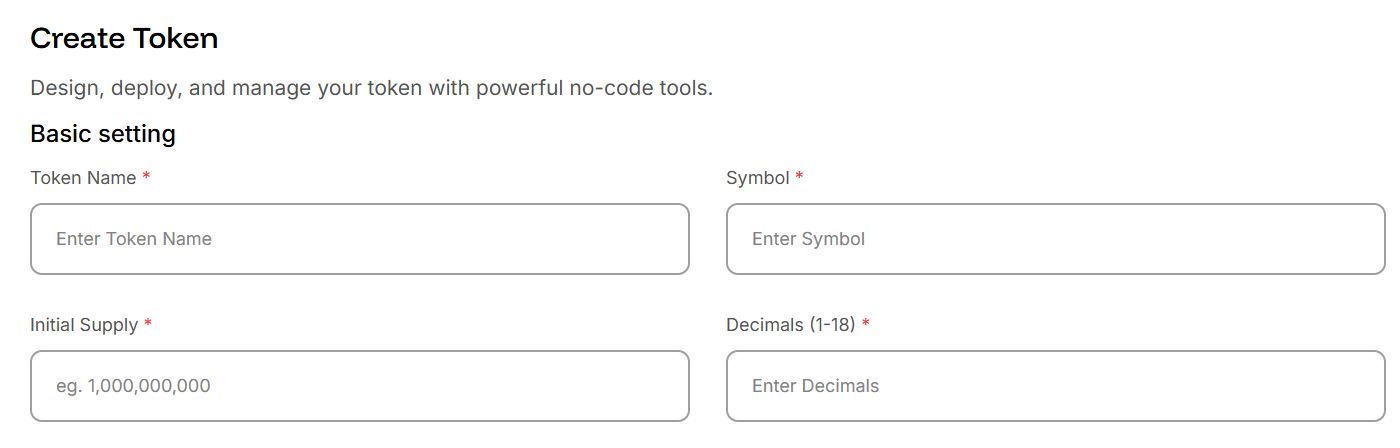
You will enter basic token information like the name, symbol, decimals, and initial supply, as these details will appear publicly once your token is final and live.
- Name is the full title of your token, like, just for reference, “FutureCoin.”
- Symbol, which is the short ticker shown in the wallets, like “FTR” for FutureCoin.
- Decimals are where you define the divisibility; like you can put 8 decimals value for your token or something else as per your choice.
So these basic inputs are enough if you just want to create a simple token but if you want more control, you can head to the advanced settings from the platforms.
Step 3: Choose your advanced settings
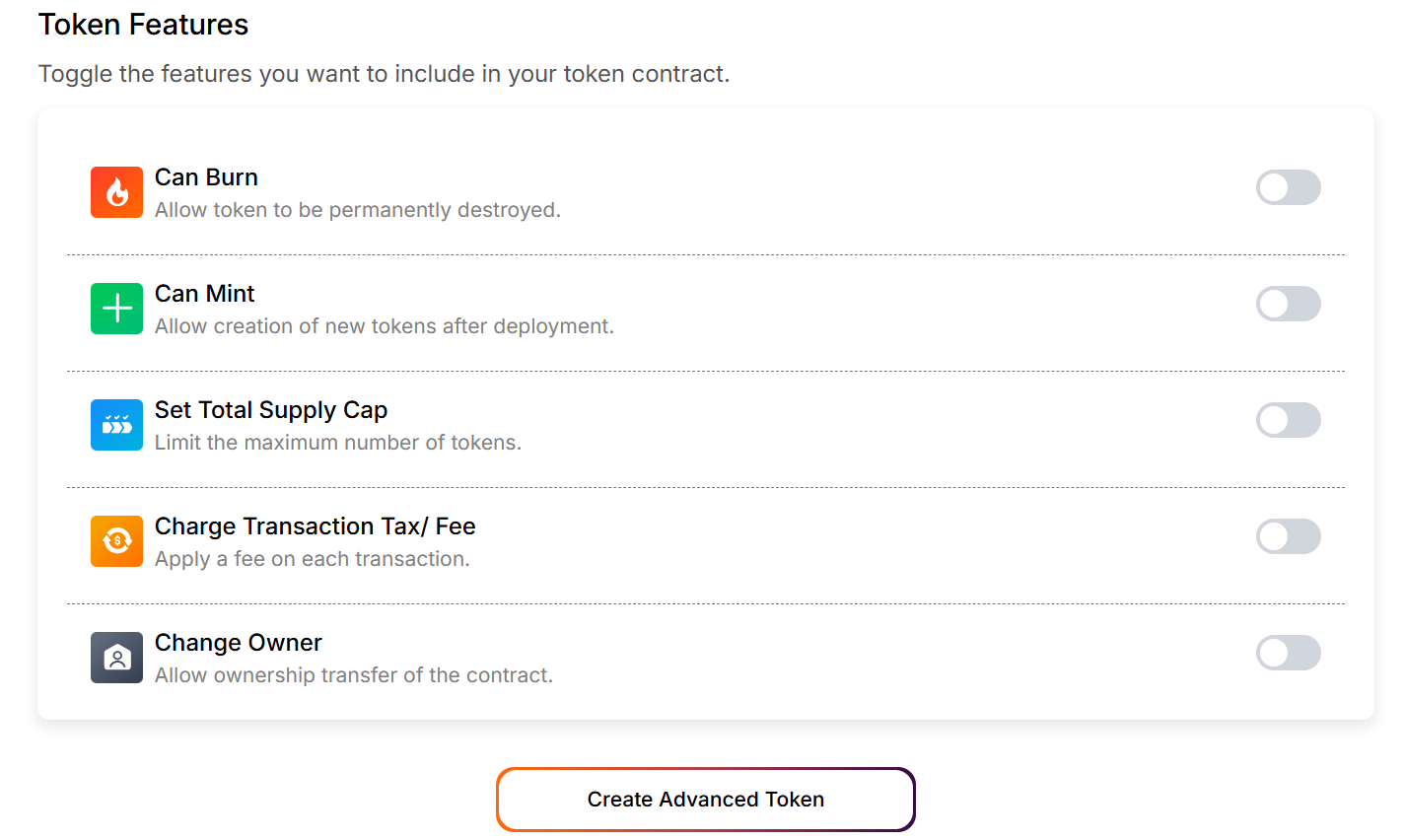
Advanced settings let creators have the flexibility to customize the token behavior, as they can enable or disable features like
- Can mint for future token creations
- Can burn for permitting users or owners to destroy the tokens
- Set Total Supply Cap to limit the total possible tokens forever.
- Charge transaction tax/fee to add a small tax on every transaction for sustainability or treasury funding.
- Change the owner toggle for transfer of ownership after the deployment.
Each of these adoptions is a switch where you do not need to touch the code, as this no-code configuration gives your token purpose and governance logic instantly.
Step 4: Launch Your Token
Once you are satisfied, you can confirm your settings and click on the “deploy” button to launch your token. Your connected wallet will pop up to confirm the transaction so you can approve it and within moments, congratulations—your token will be ready to use on the blockchain.
You can now also view it on explorers like Etherscan or Solscan or just use it for trading on DEXs and integrate it into your apps. It was a very simple journey because you can create your own crypto token in, like, under 15 minutes, and there are no developers required, no syntax errors, and no debugging nightmares your team has to go through.
Tips to create a successful token for your needs
Launching a token is simple, but again, making it valuable requires strategy so here are a few practical tips that you can use to deliver the right purpose and sustainability momentum to your token.
1. Define a clear utility
A token should have a purpose, whether it is about payments, access rights, staking, or rewards. You have to decide how users will use and benefit from your solution.
2 Design sustainably Tokenomics
You do not have to copy something just as it is and instead understand your tokenomics that will make your product sustainable. Things like managing the total supply, inflation (minting), and deflation (burning) should be picked up wisely as per the requirements; otherwise, it will just increase unnecessary weight to your tokens.
3. Choose your community early.
Businesses that try to target everything face problems in sustaining one industry so it is important to start slow. You have to choose your community early on, like if you want to target the gaming, DeFi, or social industry, and then customize your branding and utility, keeping your audience in mind.
4 Deliver right and reliable compliance
Do not ignore the regulations and standards related to crypto, which differ as per your location. Work within your jurisdiction while asset tokenizing or creating reward tokens or any other critical token so that your business remains safe and sound for the future.
5. Plan liquidity and listing rights
Avoid making things too complex and keep your asset easily tradable in the world of crypto, where you can stock a self-run crypto exchange with your assets (DEX). You can also use stable partner currency, which will help you to earn trading fees and maximize your profit.
It is true that using a no-code token creation platform lets you iterate quickly, where you can launch multiple test tokens, refine tokenomics, and then finalize your main token with confidence.
Final thoughts
Token creation is not just about technical expertise anymore; it is more about creativity and purpose. The shift to no-code platforms like Token Peddler is inspiring innovators from every background to tokenize their ideas right in just a few minutes so whether you are launching for community rewards or creating a full digital asset ecosystem, now is the time to act. If you require consultation to create your own token or want a highly customizable platform of your own, then you can connect with blockchain app development companies like NetSet Software to discuss your requirements.
FAQs
Do I need knowledge of coding to create my own token?
Not at all as you can use a crypto token creator which will create a smart contract without coding and help you launch your token instantly.
Is there a difference between ERC 20 and other standards or are they just the same?
An ERC20 token is the most common fungible token on Ethereum and other standards like BEP20 (BNB) and SPL (Solana) are their alternatives that you can use to achieve your goals.
Will no code tools also work for asset backed tokens?
Yes, why not? Many asset tokenization platform tools let you represent real-world assets, just like property or equity, using secure token standards.
How long does it take to deploy the token I made?
With no-code platforms like Token Peddler, you can deploy it in under 15 minutes.
Why is Token Peddler the best token creation platform?
Because the platform offers both basic and advanced settings for every token and is backed by one of the leading blockchain development companies, NetSet Software.

One Response