A Polygon Token Generator is a tool that enables you to deploy tokens on Polygon without any smart contract development, using a structured configuration and deployment workflow.
For a team that wants to launch a product, ecosystem, or token economics experiment, the real challenge is no longer about implementation but ensuring that your Polygon Token Generator token is correctly set up, secure, and suitable for the task.
This blog is a step-by-step guide on how to create a no-code token on Polygon, from the basics to deployment and beyond, so you don’t have to go through all the complexity.
What is Polygon? And Its Role in Token Deployment
Polygon is a scaling solution that operates on the Layer 2 scaling system of the Ethereum blockchain and is developed to improve the performance of the Ethereum network.
It enables the possibility of transacting in a faster and cheaper manner without making the transactions incompatible with the existing smart contracts and applications.
Technical Characteristics:
- Transaction costs typically remain below $0.01
- High throughput supports large-scale usage
- Full compatibility with Ethereum tooling and ERC-20 standards
- Fast confirmation times for production environments
Billions of transactions have been processed on Polygon, and a vast variety of decentralized applications are supported. This makes Polygon a practical solution for deploying tokens.
Why It Matters
- Lower cost reduces experimentation friction
- Faster execution improves deployment timelines
- Compatibility ensures wallet and exchange support
If you are preparing to create tokens on Polygon, these factors will have a direct effect on the usability and scalability of your token.
Prefer Reading: How to Create Tokens on Polygon PoS Network
What is a Polygon Token Generator and How Does It Work?
A Polygon Token Generator is a tool that enables developers to create and deploy ERC-20 smart contracts without coding. It removes the manual Solidity development process, letting you define and configure all token parameters directly.
Operational Flow:
- Input token details (name, symbol, supply)
- Select functional features (minting, burning, permissions)
- Connect wallet
- Deploy contract to the Polygon network
The system handles compilation, deployment, and initial configuration, reducing execution risk and ensuring standardized contract structures.
Instead of setting up development environments and managing contract logic manually, TokenPeddler allows structured, no-code token deployment through a single interface.
Key Token Features You Can Configure
Token configuration determines how the asset behaves in production environments.
Supply Models
- Fixed supply → controlled distribution
- Capped supply → predictable limits
- Dynamic supply → minting-enabled models
Mintable Tokens
Allow supply expansion post-deployment
Use cases: rewards, staking, incentives
Burnable Tokens
Enable permanent removal of tokens
Use cases: deflation, supply control
Access and Permissions
- Ownership control
- Role-based access
- Transfer restrictions
Advanced Logic
- Transaction fees
- Address-level restrictions
- Pause/unpause controls
These options are common to contemporary no-code polygon token creation, although a few have to be chosen wisely in accordance with the intended use of your token.
Step-by-Step Guide to Create Tokens on Polygon Using a No-Code Polygon Token Generator
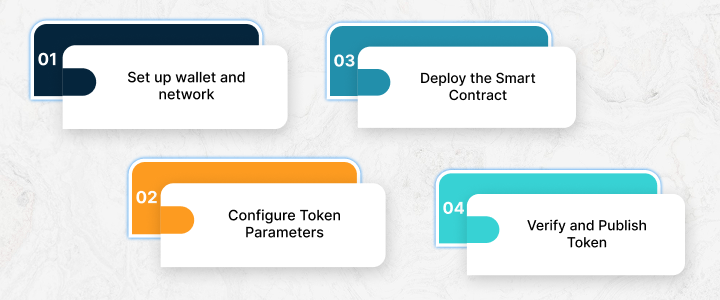
Step 1: Set Up Wallet and Network
- Install a Web3 wallet
- Configure Polygon network
- Add MATIC for gas fees
Step 2: Configure Token Parameters
Define:
- Token name and symbol
- Decimal precision
- Total supply
Enable:
- Mintable and burnable token
- Ownership permissions
Errors at this stage directly impact long-term token behavior.
Step 3: Deploy the Smart Contract
- Connect wallet
- Confirm transaction
- Pay gas fee
The system automatically synthesizes and implements the contract and the ownership is transferred to your wallet.
Step 4: Verify and Publish Token
- Verify contract on blockchain explorer
- Add token to wallet
- Enable integrations
Verification ensures transparency and third-party compatibility.
If you want to execute this workflow without managing deployment complexity, TokenPeddler provides a unified interface for configuration, deployment, and verification.
What is the Cost of Creating a Polygon Token?
Production of Polygon token is comparatively affordable. The average gas costs vary between $0.01 and $0.50 depending on the network conditions. Additional costs may include platform usage fees and optional smart contract audits.
Compared to Ethereum mainnet, this represents a significant reduction in deployment cost.
Common Mistakes to Avoid
- Incorrect supply model selection
- Unrestricted minting permissions
- Undefined token utility
- Skipping contract verification
These errors often result in structural limitations after deployment.
Security and Smart Contract Considerations
Even in no-code systems, configuration defines contract behavior.
Critical Areas:
- Permission structure
- Minting authority
- Ownership control
- Upgrade limitations
A large proportion of token vulnerabilities originate from misconfigured permissions rather than code-level flaws.
Use Cases: Where Polygon Tokens Are Applied
- Decentralized finance systems
- Gaming reward ecosystems
- Loyalty programs
- Event-based or prediction platforms
Example: A blockchain-based game can use a mintable token to incentivize users based on their achievements. More tokens can be minted as the number of users increases, and burning can be implemented to control the number of tokens in circulation.
Scaling Beyond Token Creation
Token deployment is only the first step.
Next Steps:
- Integrate with decentralized applications
- Provide liquidity
- Implement staking or governance
- Build ecosystem utility
Without these layers, tokens remain inactive despite being technically functional.
No-Code vs Custom Development: Which Approach to Choose?
Before choosing an approach, it’s important to understand the trade-off between speed and flexibility.
| Approach | Advantages | Limitations | Best Use Cases |
| No-Code Polygon Token Generator | Fast deployment, low cost | Limited flexibility | MVPs, testing, simple tokens |
| Custom Smart Contract Development | Full control, advanced logic | Higher cost, longer time | Complex token systems |
A practical strategy is to start with a generator and transition to custom development as complexity grows.
Choosing the Right Polygon Token Generator
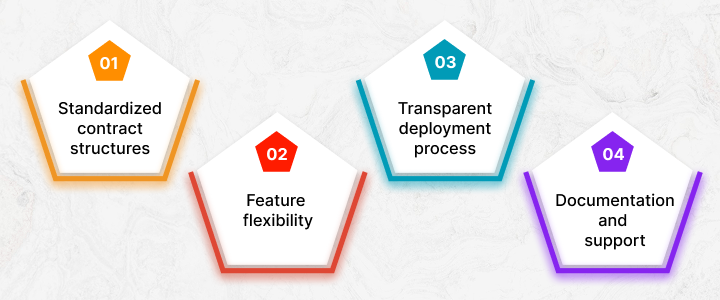
Evaluate platforms based on:
- Standardized contract structures
- Feature flexibility
- Transparent deployment process
- Documentation and support
Ensure support for:
- Mintable and burnable tokens
- Secure ownership management
- Verified contract outputs
For teams moving from concept to deployment, TokenPeddler provides a production-ready Polygon Token Generator with configurable logic and standardized contract infrastructure.
Conclusion
A Polygon Token Generator simplifies token deployment on the Polygon network by replacing manual smart contract development with a structured, user-friendly interface for configuring token parameters.
It enables:
- Faster deployment
- Lower costs
- Scalable token integration
The focus is no longer on writing contracts, but on defining how the token operates within a broader ecosystem.
Platforms like TokenPeddler simplify this process by providing structured deployment workflows that reduce execution risk while maintaining flexibility.
FAQS
Can I deploy a token on Polygon without coding?
Yes. No-code Polygon Token Generators allow users to specify supply, permissions, and functionality of the token and directly deploy it as an ERC-20 token without code writing in Solidity or smart contract management.
What is the cost of creating a Polygon token?
The deployment cost is primarily made up of gas fee, which might vary between $0.01 and 0.50 depending on the network traffic. Other related charges may include platform usage charges, token verification charges and audit charges of creating secure and compliant tokens.
What are mintable and burnable tokens?
Mintable tokens can increase total supply post-deployment for rewards or liquidity. Burnable tokens permanently reduce supply, controlling scarcity and supporting tokenomics. Both features are configurable during token generation.
Is Polygon suitable for production deployments?
Yes. Polygon is a great choice because it has high throughput, low latency, and low costs enabling it to be used in production-grade tokens, DeFi, NFTs, and any other application that requires secure, Ethereum-compatible L2 solutions.
- Can my Polygon token integrate with DeFi platforms?
Absolutely. Polygon-based ERC-20 tokens that are interoperable with wallets, DEXs, staking and lending protocols, as well as liquidity systems, enable them to be fully integrated within Ethereum-based DeFi without any contract changes.