Token deployment in blockchain ecosystems has moved from manual contract engineering toward structured, interface-driven execution. Earlier, creating an ERC20 token required Solidity programming, contract compilation, and repeated debugging across environments. That workflow increased execution time, introduced audit dependencies, and created higher implementation risk during early validation stages.
The Polygon Amoy Testnet provides a controlled environment where token behavior can be validated without financial exposure. It replicates production-level execution while allowing developers to test supply logic, transaction flows, and integration compatibility. This stage plays a critical role in preventing contract-level failures before mainnet deployment.
Using a Polygon Amoy Token Generator, teams can configure token parameters and deploy contracts without writing code. The process remains aligned with ERC20 specifications while removing engineering bottlenecks.
This guide presents a structured approach to Amoy Testnet Token creation, focusing on technical accuracy, predictable execution, and readiness for production environments with measurable deployment outcomes.
Understanding Polygon Amoy Testnet
The Polygon Amoy Testnet operates as a staging network for validating smart contracts within the Polygon ecosystem. It mirrors real execution conditions without requiring real assets.
Core capabilities:
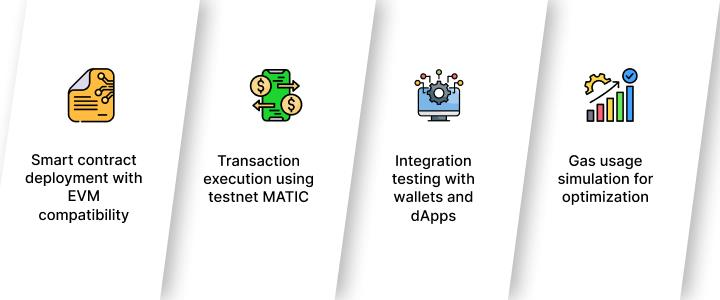
- Smart contract deployment with EVM compatibility
- Transaction execution using testnet MATIC
- Integration testing with wallets and dApps
- Gas usage simulation for optimization
For Polygon Amoy Testnet Token creation, this environment ensures contract logic executes correctly before production deployment.
ERC20 Standard: Technical Breakdown
The ERC20 token standard defines a fixed interface for convertible tokens across Ethereum-compatible blockchains. It ensures interoperability without requiring custom integrations.
Key functions
- transfer(): moves tokens between addresses
- approve(): authorizes delegated spending
- transferFrom(): executes approved transfers
- balanceOf(): retrieves account balances
- totalSupply(): tracks total token issuance
A Polygon Amoy Token Generator implements these functions using standardized templates to ensure protocol compliance.
Why Use a Polygon Amoy Token Generator?
Manual contract development introduces complexity in code validation, deployment scripting, and security review. For early-stage validation, this slows execution.
A Polygon Amoy Token Generator provides a structured alternative.
Technical benefits:
- Deterministic contract generation aligned with ERC20
- Elimination of syntax-level errors
- Reduced dependency on Solidity development
- Immediate deployment and validation cycles
Teams working with a polygon token development company often begin with generator-based deployment before scaling into custom contracts.
Step-by-Step Polygon Amoy Testnet Token Creation
Step 1: Select a Polygon Amoy Token Generator
Choose a platform with native Amoy support and transparent deployment tracking.
Evaluation parameters
- Compatibility with Polygon Amoy Testnet
- ERC20-compliant contract templates
- Contract verification capability
- Wallet integration support
Step 2: Configure Wallet for Amoy
Use an EVM-compatible wallet configured with Amoy network details.
Required setup
- RPC endpoint for Amoy
- Chain ID configuration
- Testnet MATIC for gas execution
Incorrect configuration prevents transaction broadcasting.
Step 3: Define Token Parameters
Token configuration determines contract behavior and supply mechanics.
| Parameter | Technical Role | Example |
| Name | Contract identifier | TokenPeddler |
| Symbol | Market representation | TPED |
| Supply | Total token issuance | 1,000,000 |
| Decimals | Fractional precision | 18 |
| Mintable | Supply expansion control | Enabled |
| Burnable | Supply reduction mechanism | Enabled |
Accurate configuration is essential for successful token creation.
Step 4: Deploy Smart Contract
Deployment is executed through the generator interface.
Execution flow
- Bytecode generation
- Wallet-based transaction signing
- Network broadcast to Polygon Amoy Testnet
- Contract address generation
Step 5: Validate Token Functionality
Post-deployment validation ensures contract reliability.
Validation checklist
- Token visibility in wallet
- Transfer execution
- Approval and delegated transfers
- Supply consistency
Are you ready to execute the Polygon Amoy Testnet Token creation without manual contract development? TokenPeddler enables structured ERC20 deployment using a Polygon Amoy Token Generator, allowing precise parameter configuration, controlled execution, and immediate validation of token logic within a no-code environment.
Common Implementation Failures
Decimal misconfiguration
Incorrect precision disrupts balance calculations.
Unrestricted minting
Unlimited supply expansion affects token economics.
Missing contract verification
Unverified contracts reduce transparency and traceability.
Wallet network mismatch
An incorrect network configuration prevents deployment.
TokenPeddler: Controlled Token Deployment Framework
TokenPeddler provides a no-code environment for Polygon Amoy Token Generator workflows, enabling controlled and efficient token deployment.
Capabilities
- Standardized ERC20 contract templates
- Guided Polygon Amoy Testnet Token creation workflow
- Transparent deployment execution process
- Parameter-driven token configuration
TokenPeddler operates as a self-serve token deployment platform, allowing teams to design, deploy, and validate tokens without manual smart contract development. It serves as a practical solution for early-stage validation before moving to custom development.
Industry Data and Adoption Trends
- More than 60 percent of blockchain projects are validated on testnets
- Polygon ecosystem supports high-volume ERC20 deployments
- No-code tools reduce development cycles by up to 80 percent
- Testnet validation reduces contract failure rates significantly
These trends support adopting Polygon Amoy Testnet Token creation workflows before the mainnet release.
Business Impact of No-Code Token Deployment
Creating tokens through traditional smart contract development often takes 2–3 weeks, including coding, testing, and validation.
A no-code approach reduces that timeline significantly.
Measurable impact:
- Reduce validation cycle from 2–3 weeks to under 1 day
- Cut early-stage development cost by up to 70%
- Validate token economics before allocating engineering resources
- Identify contract-level issues before mainnet exposure
This approach allows faster iteration and better decision-making during early-stage token design.
Conclusion
Creating ERC20 tokens on Polygon Amoy Testnet without coding is now a structured and execution-focused process aligned with modern blockchain practices. A Polygon Amoy Token Generator enables rapid deployment while maintaining compliance with ERC20 standards.
The focus remains on validation accuracy. Each parameter, transaction, and integration test contributes to contract stability. Ignoring these steps introduces risk during mainnet deployment.
Validate your token model on Polygon Amoy before committing development resources. With TokenPeddler, you can configure, deploy, and test your ERC20 token in minutes, reducing time, cost, and execution risk.
FAQ’s
What is Polygon Amoy Testnet used for?
Polygon Amoy Testnet enables validation of ERC20 tokens and smart contracts in a controlled environment, ensuring accurate transaction execution and integration testing before mainnet deployment.
Can ERC20 tokens be created without coding?
Yes, a Polygon Amoy Token Generator in TokenPeddler enables structured token deployment through predefined templates, eliminating manual Solidity development while maintaining ERC20 compliance.
Is deployment on Polygon Amoy Testnet free?
Yes, transactions use faucet-based test MATIC, allowing cost-free deployment and testing of tokens.
How long does token deployment take?
Deployment typically completes within minutes, depending on transaction confirmation time on the network.
Why is testnet validation required before mainnet?
It ensures contract logic, transaction flows, and integrations function correctly, reducing deployment risks.