
Stablecoins have become an important part of the broader blockchain economy. What started primarily as a way to reduce crypto-market volatility is now being explored for payments, digital settlements, cross-border transactions, Web3 applications, and tokenized business models. For companies considering blockchain adoption in 2026, launching a stablecoin can offer an opportunity to build programmable financial infrastructure around a specific business requirement.
However, creating a stablecoin is very different from simply deploying a standard crypto token. A business needs to think about the asset backing the token, issuance and redemption, smart contract security, blockchain selection, governance, compliance, and ongoing monitoring.
This is where custom token development becomes important. Instead of creating a generic asset, businesses can design the token’s technical and operational structure around their specific objectives.
What Is a Custom Stablecoin?
A stablecoin is a blockchain-based digital asset designed to maintain a relatively stable value against another asset. The most common reference is a fiat currency such as the U.S. dollar, although different stablecoin models can use other assets or mechanisms.
For a business, a custom stablecoin can be designed around a particular payment or settlement ecosystem. For example, a company could potentially use it within a digital marketplace, Web3 application, payment platform, or tokenized asset ecosystem.
The important distinction is that the token’s stability does not come merely from a number written into its smart contract. The mechanism supporting its value, the assets backing it, the redemption process, market liquidity, and governance all matter.
Therefore, businesses should approach custom token development as a combination of blockchain engineering, financial design, security, and operational planning.
Why Businesses Are Considering Stablecoins in 2026
The growing use of blockchain infrastructure has encouraged businesses to explore digital assets beyond speculative trading. Stable-value tokens can potentially make blockchain applications easier to use because users do not have to deal with the same degree of price volatility associated with many cryptocurrencies.
For businesses operating internationally, stablecoins may also be considered for digital settlement and cross-border transactions. A company building a Web3 marketplace could use a stable-value asset as a payment layer, while a tokenization platform could integrate one as a settlement asset.
The value proposition ultimately depends on the business model. Transaction volume, target markets, liquidity, regulatory requirements, existing payment infrastructure, and the selected blockchain all influence whether a stablecoin makes sense.
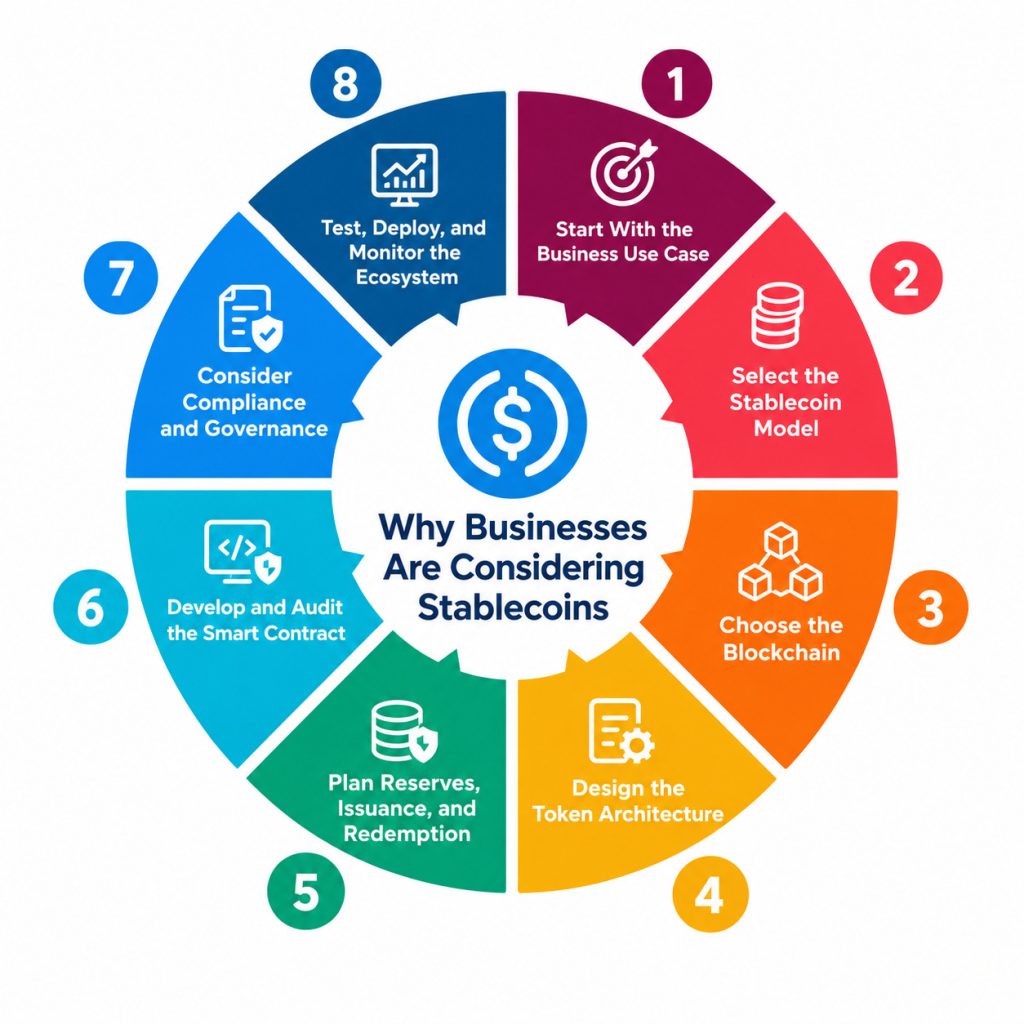
Step 1: Start With the Business Use Case
The first stage of a stablecoin project should happen before any smart contract is written. Define exactly what the token is expected to accomplish.
A business might want a stablecoin for customer payments, B2B settlements, cross-border transactions, a Web3 ecosystem, tokenized assets, or an internal digital economy. Each use case creates different technical and operational requirements.
You should identify who will use the token, how it will enter circulation, where it can be used, whether users can redeem it, and what geographical markets will be supported.
A well-defined use case also helps prevent unnecessary features from being added during development. In our experience with blockchain projects, a clear product specification at the beginning can save considerable development effort later.
Step 2: Select the Stablecoin Model
There is no single architecture that works for every stablecoin.
A fiat-backed model uses traditional assets or reserves intended to support the value of issued tokens. Such a model requires appropriate custody arrangements, reserve management, reconciliation, and redemption procedures.
A crypto-backed model uses digital assets as collateral. Since cryptocurrencies can be volatile, these systems may require overcollateralization and additional risk-management mechanisms.
Algorithmic models take a different approach by attempting to maintain stability through programmed supply and market mechanisms rather than conventional reserve backing. These designs can be technically and economically complex and should be evaluated carefully.
The choice should be based on the intended use case, risk profile, jurisdiction, liquidity requirements, and operational capabilities rather than simply selecting the easiest option to implement.
Step 3: Choose the Blockchain
Blockchain selection can have a direct impact on transaction costs, performance, ecosystem compatibility, wallet support, and future scalability.
Ethereum remains widely used for smart-contract applications, while Solana offers a high-throughput environment that may suit applications requiring large transaction volumes. BNB Chain and other compatible networks can also be considered depending on the project’s requirements.
Businesses exploring how to create Solana token assets should evaluate Solana’s token infrastructure, wallet ecosystem, developer tooling, and integration requirements before making a decision. Similarly, teams looking for a BEP20 token generator may find token creation easier for straightforward BEP20 assets, but a stablecoin with specialized functionality can require considerably more than a basic generator provides.
The blockchain should therefore be selected based on technical requirements rather than popularity alone.
Step 4: Design the Token Architecture
After selecting the network, the development team can define the token’s smart contract architecture.
A basic token may only require standard transfer and supply functions. A stablecoin can require additional capabilities depending on its business model, including controlled minting, burning, access management, emergency mechanisms, transaction monitoring integrations, and other administrative functions.
Every privileged function should have a clear purpose. Administrative keys should also be protected using appropriate security practices.
Good architecture is not about adding as many features as possible. It is about implementing only the functionality required by the product while reducing unnecessary attack surfaces.
Step 5: Plan Reserves, Issuance, and Redemption
For reserve-backed stablecoins, the off-chain operational model is just as important as the blockchain contract.
The business needs a clear process for issuing tokens and determining when new supply can be created. It must also establish how supporting assets are held, reconciled, and reported.
Redemption is another critical consideration. If users are entitled to redeem tokens under defined conditions, the business needs the infrastructure and operational process to handle those requests.
This creates a connection between the blockchain and traditional financial operations. Token supply, reserve positions, and redemption activity need to be monitored consistently.
A technically flawless smart contract cannot compensate for weak reserve or operational controls.
Step 6: Develop and Audit the Smart Contract
Smart contract security should be considered throughout the development lifecycle rather than immediately before launch.
Development teams should test the contract against expected transactions as well as unusual and potentially malicious scenarios. Access controls, minting permissions, burning mechanisms, supply limits, emergency functions, and upgrade mechanisms should all be tested where applicable.
Independent security audits can provide another layer of assurance. Businesses should also establish procedures for responding to vulnerabilities discovered after deployment.
For companies investing in custom token development, security testing should be treated as part of the product rather than an optional final step.
Step 7: Consider Compliance and Governance
Stablecoins can intersect with financial, payments, consumer-protection, AML, tax, and other regulatory requirements. The applicable rules can vary significantly according to the token structure, issuer, users, and jurisdiction.
For this reason, legal and compliance analysis should begin before launch. Technical teams can implement the required infrastructure, but businesses should obtain advice from qualified professionals regarding the laws applicable to their specific project.
Governance also needs to be defined. Determine who can manage the smart contract, who can issue or pause tokens, how emergency situations are handled, and how future upgrades are approved.
Clear governance reduces uncertainty and makes the project easier to operate as it grows.
Step 8: Test, Deploy, and Monitor the Ecosystem
Testing should cover both the smart contract and the wider product. Wallet integrations, APIs, payment flows, dashboards, administrative interfaces, and blockchain interactions should be tested before production deployment.
Once the stablecoin goes live, monitoring becomes an ongoing responsibility. Teams need visibility into token supply, transactions, contract activity, security alerts, reserve-related information, and system performance.
Maintenance may also involve updating integrations, improving monitoring tools, responding to security issues, and adapting the infrastructure as the business grows.
A stablecoin should therefore be treated as a long-term technology product rather than a one-time token launch.
Stablecoin Development Roadmap: From Idea to Launch
The overall process can be simplified into the following stages:
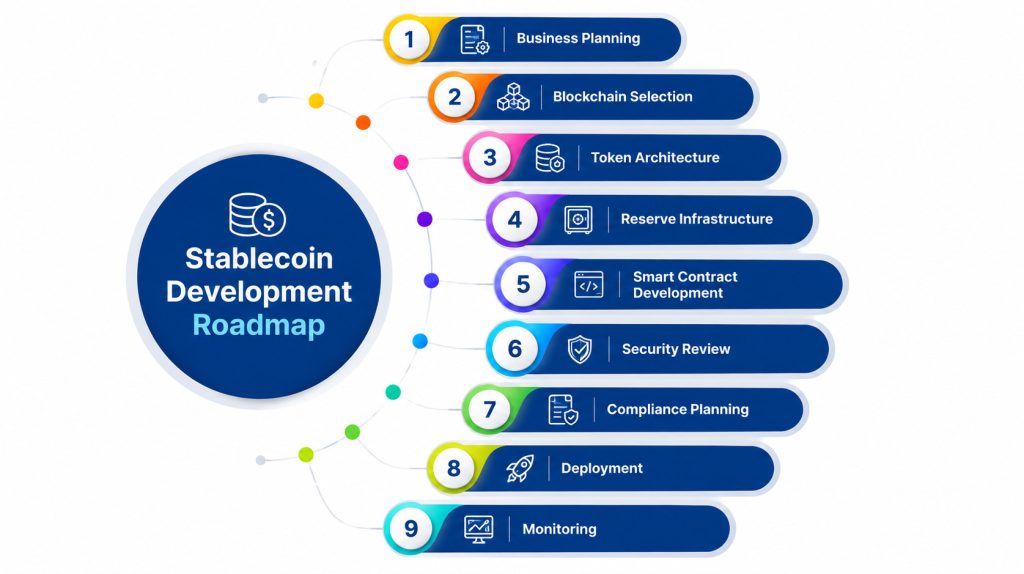
- Business Planning: Define the purpose, users, markets, and economic model.
- Blockchain Selection: Evaluate networks according to cost, speed, scalability, and ecosystem compatibility.
- Token Architecture: Define supply, minting, burning, permissions, and required smart contract functions.
- Reserve Infrastructure: Establish custody, issuance, reconciliation, and redemption processes.
- Smart Contract Development: Build and test the blockchain components.
- Security Review: Conduct testing and, where appropriate, an independent audit.
- Compliance Planning: Review applicable legal and regulatory obligations.
- Deployment: Launch the token and connect the required wallets, applications, and services.
- Monitoring: Track blockchain activity, supply, security, and operational performance.
This roadmap gives businesses a practical framework for moving from an initial concept toward a production-ready ecosystem.
Can a Token Creation Platform Help?
Not every business needs to build every token component from the ground up. For projects that require a standard blockchain asset, token creation platforms can simplify the initial setup and reduce the technical work involved in deployment.
Businesses looking for a create my token solution can explore platforms such as Token Peddler, which offers streamlined token creation workflows for supported blockchain networks. It can be a practical starting point for teams that want to configure essential token details and move through the deployment process without handling every basic development task manually.
However, creating a standard token is different from building a complete business-grade stablecoin. A stablecoin may require specialized smart contracts, reserve management, redemption mechanisms, governance controls, compliance procedures, security reviews, and integrations with external business systems.
For this reason, a token generator can be useful for straightforward token creation, prototyping, and standard asset deployment, while a fully operational stablecoin often requires a broader custom token development approach. Using the right tool at each stage can help businesses reduce unnecessary development effort while still addressing the technical, financial, and operational requirements of a stablecoin.
Final Thoughts
Creating a custom stablecoin in 2026 requires considerably more planning than simply deploying a token contract. The technology needs to work alongside the business model, reserve structure, security architecture, governance framework, and applicable compliance requirements.
Businesses that begin with a clearly defined purpose can make better decisions about blockchain selection, token architecture, development tools, and supporting infrastructure.
Whether your objective is to create my token for a Web3 ecosystem or develop a stable-value asset for business payments, the focus should remain on building a secure, transparent, and sustainable product.
The right development approach is ultimately determined by what the business needs the token to accomplish, not by how quickly the token can be deployed.
FAQ’s
What is custom token development?
Custom token development is the process of creating a blockchain token around specific business requirements, including its supply, functionality, permissions, utility, and integrations.
Can I create a Solana token for my business?
Yes. Businesses can create tokens on Solana, but the required development approach depends on the token’s purpose, functionality, and ecosystem requirements.
What does a BEP20 token generator do?
A BEP20 token generator simplifies the creation of tokens compatible with the BEP20 standard on BNB Chain. More complex projects may require customized smart contract development.
How much does custom token development cost?
The cost varies according to blockchain, smart contract complexity, integrations, security requirements, compliance needs, and supporting infrastructure.
Is creating a stablecoin the same as creating a normal token?
No. A stablecoin requires mechanisms and operational processes intended to support price stability, making the project substantially more involved than creating a basic token.