
Ethereum has changed the way businesses and developers think about blockchain applications. From decentralized finance and NFTs to tokenized assets and Web3 applications, its technology has become a foundation for countless blockchain projects.
But what if you need a blockchain with your own rules, transaction structure, validators, or economic model?
That is where an Ethereum blockchain clone comes into the picture. Instead of building a blockchain concept from zero, developers can use Ethereum’s architecture and EVM compatibility as a foundation and customize it for a particular business or application.
In 2026, however, there is an important distinction to understand. Building an entire blockchain is very different from launching a token on an existing network. Before starting development, businesses should determine which approach actually matches their objectives.
What Is an Ethereum Blockchain Clone?
An Ethereum blockchain clone is a blockchain network designed around Ethereum’s core architecture and concepts while allowing developers to customize its technical and economic parameters.
An EVM-compatible network can support familiar technologies such as Solidity smart contracts, Ethereum-compatible wallets, decentralized applications, and existing development tools.
The real value comes from customization. Depending on the project, developers can change the consensus mechanism, transaction fees, block time, validator structure, native currency, and other network parameters.
However, cloning Ethereum does not mean copying a few files and launching a network. A production-ready blockchain requires proper architecture, testing, security reviews, node infrastructure, monitoring, and ongoing maintenance.
How to Build an Ethereum Blockchain Clone
The first step is to clearly define what the blockchain is supposed to accomplish. A network designed for a gaming ecosystem will have different requirements from one built for enterprise applications or tokenized assets.
You should establish the intended users, transaction volume, level of decentralization, validator model, smart-contract requirements, and whether the network will be public, private, or permissioned.
Once these requirements are clear, the technical architecture can be planned.
1. Select the Blockchain Architecture
Ethereum’s EVM is one of the most useful components to consider because it gives developers compatibility with a mature smart-contract ecosystem.
An EVM-compatible blockchain can allow developers to work with Solidity and familiar Ethereum development tools instead of creating an entirely new smart-contract environment.
The architecture should also define how blocks are produced, how transactions are validated, how nodes communicate, and how network fees are handled.
Consensus is particularly important. A public blockchain may require a different approach from a private enterprise network. Proof of Stake, Proof of Authority, and other models each come with different trade-offs involving decentralization, performance, security, and infrastructure requirements.
2. Configure Nodes and Network Parameters
After selecting the architecture, developers need to establish the blockchain’s network configuration.
Nodes maintain blockchain data and communicate with other participants. They are responsible for processing transactions, validating blocks, and keeping the network synchronized.
At this stage, developers configure elements such as block timing, gas or transaction fees, network identification, validator settings, and the genesis configuration.
A local development network should normally be created first. It provides a controlled environment for testing basic transactions and smart-contract behavior before introducing multiple nodes.
3. Add Smart-Contract Support
Smart contracts are at the heart of most Ethereum-based applications.
With an EVM-compatible blockchain, developers can use Solidity to create applications and digital assets. Existing development frameworks can also simplify testing and deployment.
This is where custom token development can become part of the broader blockchain strategy.
For example, a business may create a native asset for payments, rewards, governance, or access to a particular service. The token’s supply, permissions, utility, and distribution model should be defined before deployment.
However, businesses should not assume that building a blockchain is necessary just because they want a token. If the primary objective is to create my token, an existing blockchain may provide a much simpler solution.
4. Connect Wallets and Applications
A blockchain becomes useful when applications and users can interact with it.
Developers therefore need reliable RPC endpoints that allow wallets and decentralized applications to communicate with network nodes. Wallet integration, transaction APIs, explorers, and monitoring tools may also be required.
For a public network, infrastructure reliability is particularly important. Slow or unreliable RPC services can affect the user experience even when the underlying blockchain is functioning correctly.
5. Test Before Mainnet Deployment
Testing should take place long before the blockchain is opened to real users.
A dedicated testnet can be used to evaluate transactions, block production, smart-contract execution, node synchronization, validator behavior, and network recovery.
Security testing is equally important. Smart contracts should be reviewed for vulnerabilities, while the broader network should be assessed for potential attack vectors and configuration weaknesses.
Performance testing should also simulate realistic transaction loads. A network that performs well during development may behave differently when hundreds or thousands of users interact with it simultaneously.
Ethereum Blockchain Clone Development Process
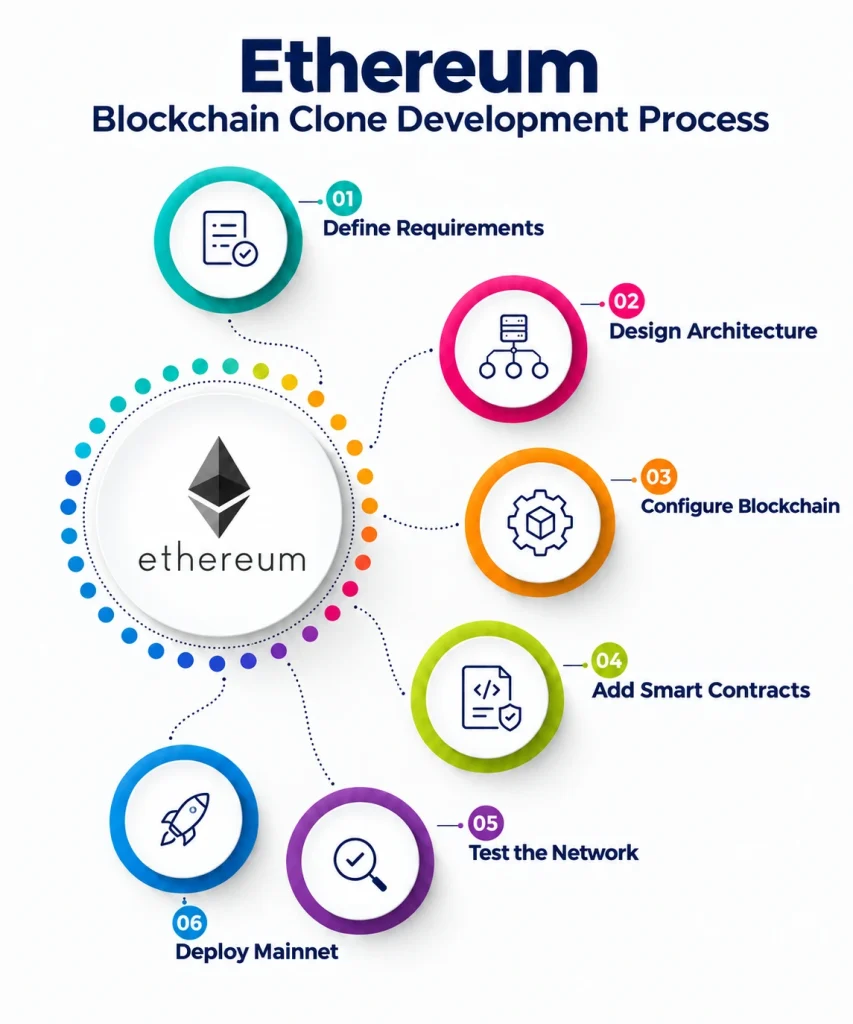
Deploying the Blockchain to Mainnet
Once the testnet has been thoroughly evaluated, the production environment can be prepared.
Mainnet deployment generally involves setting up production nodes, configuring validators, establishing RPC infrastructure, deploying monitoring systems, and making the network accessible to users and applications.
A production launch should also include operational documentation. Teams need procedures for upgrades, security incidents, node failures, backups, and ongoing maintenance.
This is an important point that is sometimes overlooked: blockchain development does not end when the first block is produced. A reliable network requires continuous monitoring and technical management.
Do You Really Need an Ethereum Blockchain Clone?
For some projects, building a blockchain from scratch or creating an Ethereum-style network makes sense. For others, it may introduce unnecessary complexity.
If your primary requirement is to launch a digital asset, an existing blockchain can often provide everything you need.
For example, developers may create Solana token free in a test environment to validate a token concept before moving toward production. Similarly, projects targeting the BNB ecosystem can use a BEP20 token generator to simplify token creation instead of developing an entire blockchain network.
The decision should therefore be based on the actual business requirement rather than the assumption that owning a blockchain is always better.
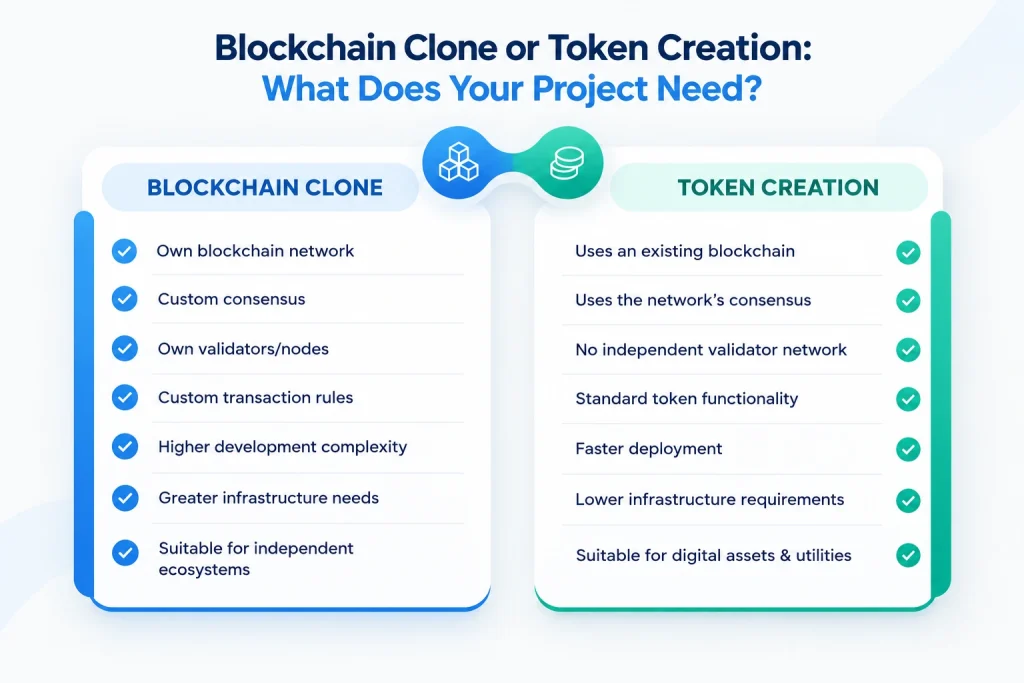
Blockchain Clone vs Token Creation
| Blockchain Clone | Token Creation |
| Own blockchain network | Uses an existing blockchain |
| Custom consensus | Uses the network’s consensus |
| Own validators/nodes | No independent validator network |
| Custom transaction rules | Standard token functionality |
| Higher development complexity | Faster deployment |
| Greater infrastructure needs | Lower infrastructure requirements |
| Suitable for independent ecosystems | Suitable for digital assets & utilities |
Where Custom Token Development Fits In
A blockchain and a token can work together, but they solve different problems.
A blockchain provides the infrastructure for recording transactions and executing decentralized applications. A token represents a digital asset that operates on that infrastructure.
For businesses planning an ecosystem, custom token development may therefore be one part of a larger blockchain strategy.
But if the business only needs a token, developing an entire blockchain could consume considerable time and resources without providing a meaningful advantage.
This is why the project requirements should be evaluated first. The technology should support the business model, not the other way around.
Can Token Peddler Simplify Token Creation?
Businesses that want to focus on their digital asset rather than blockchain infrastructure can consider a no-code token creation platform such as Token Peddler.
Token Peddler is designed to simplify token creation by allowing users to configure token details through a more accessible workflow rather than building every contract component manually.
For founders, creators, and businesses that simply want to create my token, this approach can remove some of the technical barriers involved in traditional token development.
It is particularly useful when the requirement is token creation on an existing supported blockchain rather than operating an independent blockchain network.
Final Thoughts
Building an Ethereum blockchain clone in 2026 is a serious technical undertaking. It involves architecture, consensus, nodes, smart contracts, security, testing, infrastructure, and long-term maintenance.
The biggest mistake is starting development before defining the actual requirement.
If your business needs an independent network with customized rules and infrastructure, an Ethereum-compatible blockchain can provide a strong foundation. But if the objective is simply to launch a digital asset, using an existing blockchain and focusing on custom token development may be the more practical route.
The right choice ultimately depends on your project’s technical requirements, budget, scalability expectations, security needs, and long-term business goals.
FAQs
What is an Ethereum blockchain clone?
An Ethereum blockchain clone is a customized blockchain network based on Ethereum’s architecture and concepts. It can provide EVM compatibility while allowing developers to customize network rules, consensus, fees, validators, and other parameters.
How long does it take to build an Ethereum blockchain clone?
The timeline depends on the level of customization. A basic development network can be created relatively quickly, while a secure production blockchain requires considerably more time for architecture, testing, auditing, infrastructure, and deployment.
Do I need a blockchain to create my token?
No. If your primary objective is to create my token, you can deploy a token on an existing blockchain. Building a separate blockchain is generally necessary only when you need your own network, validators, consensus mechanism, and transaction rules.
Can I create a Solana token without building a blockchain?
Yes. Solana already provides the underlying blockchain infrastructure. Developers can create and test tokens on Solana without operating a separate blockchain network.
What is the benefit of using a BEP20 token generator?
A BEP20 token generator can simplify the process of configuring and deploying a compatible token on the BNB ecosystem. It can be useful for businesses that need a token without the complexity of developing an entire blockchain from scratch.