The Real-world asset (RWA) tokenization system establishes financial infrastructure by transforming legally recognized ownership rights of real estate, government bonds, private loans, and commodity assets into digital securities that operate on blockchain technology.
Through tokenization, assets get represented as digital tokens, which users can program while the tokens maintain legal ownership rights that depend on specific local laws.
Boston Consulting Group predicts that tokenized asset value will attain $16 trillion by 2030 because institutional investors will adopt these assets at a rate that equals 10 percent of worldwide economic output.
Ton-chain tokenized asset exposure exceeds $12 billion across sovereign debt, private credit, and commodities across sovereign debt markets, private credit markets, and commodity markets.
The current figures demonstrate that institutions have made their first investment in digital tokenized assets, while retail participation remains constrained by onboarding friction, regulatory uncertainty, and limited distribution access
The growth of this industry has resulted in North American and European, and Asia-Pacific and Middle Eastern countries developing their regulatory frameworks, which concentrate on asset classification and custody and investor protection mechanisms.
Key Takeaways
- Tokenization is integrated into the current financial market infrastructure, such as custody, clearing, and settlement infrastructure.
- The most saturated markets are the private credit, tokenized sovereign debt, and commodity-backed instruments.
- Smart contracts enforce compliance rules, transfer restrictions, and investor eligibility at the protocol level.
- The volume of liquidity in the secondary market is still limited because of regulatory fragmentation and a lack of venue interoperability.
- Direct licensing, disclosure requirements, and permissions to trade are directly derived based on the classification of tokens.
- Tokenization integrates into the existing financial framework rather than replacing it.
What is Real World Asset Tokenization?
Real-world asset tokenization is the structured issuance of blockchain-based tokens that represent legally enforceable rights to off-chain assets.
Tokens operate as a digital representation layer linked to legal ownership through SPVs, trusts, or regulated fund structures.
Tokenization consolidates onboarding, registry management, settlement, and reporting into a unified ledger-based system.
It also enables fractionalization. A token can represent a specific portion of an asset, allowing distribution in smaller units without altering the economic structure of the asset itself.
Market Development and Institutional Adoption
The tokenization market has evolved from early-stage experimentation into infrastructure-backed deployment.
- 2017–2019: Initial security token offerings and early digital issuance platforms emerge.
- 2020–2022: Growth in custody solutions, regulated exchanges, and institutional experimentation.
- 2023–Present: Expansion of tokenized Treasury products, private credit pools, and fund structures.
Institutional adoption was accelerated courtesy of JPMorgan Chase’s Onyx, a platform that processed transactions worth over $900bn in tokenized form.
What Types of Assets Are Being Tokenized?
Current on-chain data shows clear concentration across specific asset segments.
Private Credit
Private credit represents the dominant RWA segment, driven by structured lending, receivables financing, and SME credit pools.
- Active on-chain exposure exceeds $18 billion
- Cumulative originations surpass $30 billion
- Common structures include SME financing, secured loans, and receivables
U.S. Treasury Products
Tokenized Treasury exposure has become a major use case.
- Over $9 billion in tokenized Treasury assets
- Used for short-duration alternative strategies and liquidity management
Commodities
Commodity tokens are physical assets in digital form.
- Market size is over $3.5 billion
- Gold tokens are the most popular, with over 80% share
Tokenized Funds
Tokenized fund structures are expanding steadily.
- Approximately $2.9 billion in tokenized fund exposure
- Includes money market strategies and structured investment products
These categories highlight where tokenization is currently operational rather than theoretical.
How Real World Asset Tokenization Works?
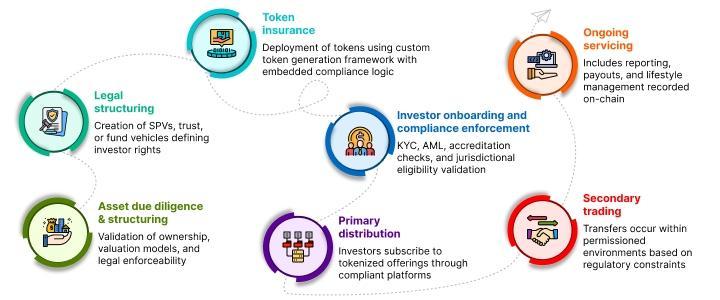
The asset tokenization process follows a structured sequence.
- Asset due diligence and structuring
Validation of ownership, valuation models, and legal enforceability. - Legal structuring
Creation of SPVs, trusts, or fund vehicles defining investor rights - Token issuance
Deployment of tokens using custom token generation frameworks with embedded compliance logic - Investor onboarding and compliance enforcement
KYC, AML, accreditation checks, and jurisdictional eligibility validation. - Primary distribution
Investors subscribe to tokenized offerings through compliant platforms - Secondary trading
Transfers occur within permissioned environments based on regulatory constraints - Ongoing servicing
Includes reporting, payouts, and lifecycle management recorded on-chain
Security Tokens vs Utility Tokens in Tokenized Economies
Misclassification exposes issuers to securities enforcement actions across jurisdictions.
| Category | Description | Common Use Cases | Regulatory Implications |
| Security Tokens | Tokens that represent ownership or financial rights related to the asset. | Tokenized shares of real estate, revenue-sharing tokens, tokenized equity, and debt. | Subject to securities laws, disclosure requirements, and a highly regulated environment. |
| Utility Tokens | Tokens providing access to a platform or digital ecosystem. | Governance participation, network usage, and platform access. | May fall outside securities classification, but are closely reviewed to ensure they are not structured as investment products. |
Correct classification is critical during the creation of security tokens, as it determines compliance obligations and distribution models.
Benefits of Tokenized Assets
Tokenization introduces measurable improvements across asset lifecycle management.
1. Broader participation
Fractional ownership facilitates reducing barriers to participation and allows for diversified participation.
2. Integrated operations
Onboarding, compliance, and reporting occur within an integrated framework.
3. Faster settlement
Atomic settlement reduces counterparty risk and eliminates multi-day clearing cycles.
4. Transparent data environment
Real-time verification through auditability and on-chain records of ownership and transactions.
Risks and Challenges
Despite progress, several constraints remain.
- Regulatory fragmentation:
The existence of jurisdictional inconsistency in securities classification and the licensing regimes.
- Technology gaps:
Smart contract vulnerabilities, oracle dependencies, and legacy infrastructure integration constraints.
- Liquidity limitations:
Limited secondary market depth due to restricted trading venues and compliance constraints.
- Custody frameworks:
Institutional adoption depends on secure and clearly defined asset custody models.
The International Organization of Securities Commissions and the Bank for International Settlements, together with the International Organization of Securities Commissions, have recognized these limitations as the main obstacles that prevent their organizations from reaching greater operational capacity.
Licensing and Regulatory Considerations
The tokens which reflect financial rights are governed by the current securities laws, where the issuers should be registered, comply with disclosure, licensed middlemen, and trade platforms.
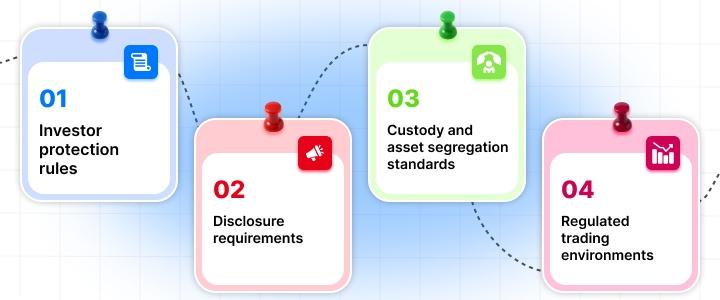
When a token is a financial right, it is normally categorized as a part of the existing securities frameworks. This means issuers and platforms must comply with:
- Investor protection rules
- Disclosure requirements
- Custody and asset segregation standards
- Regulated trading environments
Regulators follow a consistent principle: same activity, same risk, same regulatory outcome.
This means tokenization does not change the legal nature of an asset; it changes how it is issued and managed.
Role of Tokenization Infrastructure
Platforms enabling custom token generation are becoming central to this ecosystem.
Token infrastructure providers like TokenPeddler is a no-code smart contract framework that allows the creation and deployment of blockchain-based tokens with configurable token parameters, and built-in lifecycle management functions without offering regulatory compliance, onboarding of investors, or issuance of securities.
Conclusion
RWA tokenization is transitioning into regulated financial infrastructure, supported by institutional capital, compliant issuance platforms, and evolving regulatory alignment across global markets.
The regulatory landscape is also changing to match this adoption rate in asset tokenization. Regulators in major markets are not underlying assets but rather applying existing frameworks to blockchain technology.
Tokenization is expected to become a mainstream infrastructure for managing financial assets in a digitally native world as advancements in smart contract security, oracle reliability, and interoperability protocols reduce execution risk.
When your token program is experiencing technical complexity, sluggish implementation, or issues with setting token parameters, inefficiencies in execution may rise with time.
TokenPeddler offers an organized, no-code model of token creation by making it easy to deploy custom smart contracts, standardizing token settings, and making lifecycle and distribution management tools easy to use.
______________________________________________________
- How do institutions adopt RWA tokenization?
RWA tokenisation is enforced by regulatory bodies in regulated platforms, SPVs, and fund structures to make it legally binding. However, TokenPeddler is a token-generation platform that offers no-code capabilities to generate and deploy tokenization using blockchains, without any regulation of asset tokenization, compliance regimes, or onboarding investors.
- Which assets are most commonly tokenized?
The highest tokenization of assets is primarily in the real estate, private credit, U.S. Treasury bonds, commodities like gold, and investment funds. Tokenization does not alter the rights of the underlying asset. It gives the possibility of fractional ownership.
- How does tokenization improve liquidity for investors?
This increases the liquidity level by offering fractional ownership, on-blockchain settlement options, and secondary market trading with regulations.
- What legal structures support RWA tokenization?
Legal frameworks such as SPVs, trusts, and regulated fund vehicles are used to link the digital tokens with the underlying assets.
- How is regulatory compliance enforced in tokenized assets?
Regulations are maintained by the smart contract regulations, as well as the KYC/AML regulations and jurisdictional regulations.

Видеослоты — являются самые востребованные развлечения в онлайн-казино.
https://edu4all.fashiopnpromo.ru/Ye6bqYj0bjsi/